Quick Answer: The 7 minute rule allows employers to round employee clock-in and clock-out times to the nearest quarter-hour. Punches of 1–7 minutes round down; punches of 8–14 minutes round up. This rounding is legal under FLSA at 29 CFR 785.48, but only if it averages out neutrally over time.
If your employer rounds your clock-in and clock-out times instead of recording them to the exact minute, you’re working under a time rounding policy. The most common one is called the 7 minute rule, and knowing how it works can help you catch errors before they hit your paycheck.
Time rounding or 7 Minute Rule is legal under federal law, but only under specific conditions. When those conditions aren’t met, workers can lose significant pay over time, and employers face serious legal consequences.
Table of Contents
What Is the 7 Minute Rule?
The 7 minute rule allows employers to round employee time to the nearest quarter-hour. Time of 1 to 7 minutes may be rounded down, while time of 8 to 14 minutes must be rounded up and counted as a full quarter hour of worked time.
Each 15-minute window has a midpoint. If your punch falls in the first half, it rounds back. If it falls in the second half, it rounds forward.
- Clock-in at 9:07 → rounds back to 9:00 (7 minutes, rounds down)
- Clock-in at 9:08 → rounds forward to 9:15 (8 minutes, rounds up)
The name comes from that cutoff: 7 minutes rounds down, 8 minutes rounds up. This 7 minute rule is authorized under federal law at 29 CFR 785.48, the Department of Labor’s regulation on hours worked.
The Three Approved Rounding Methods Under FLSA
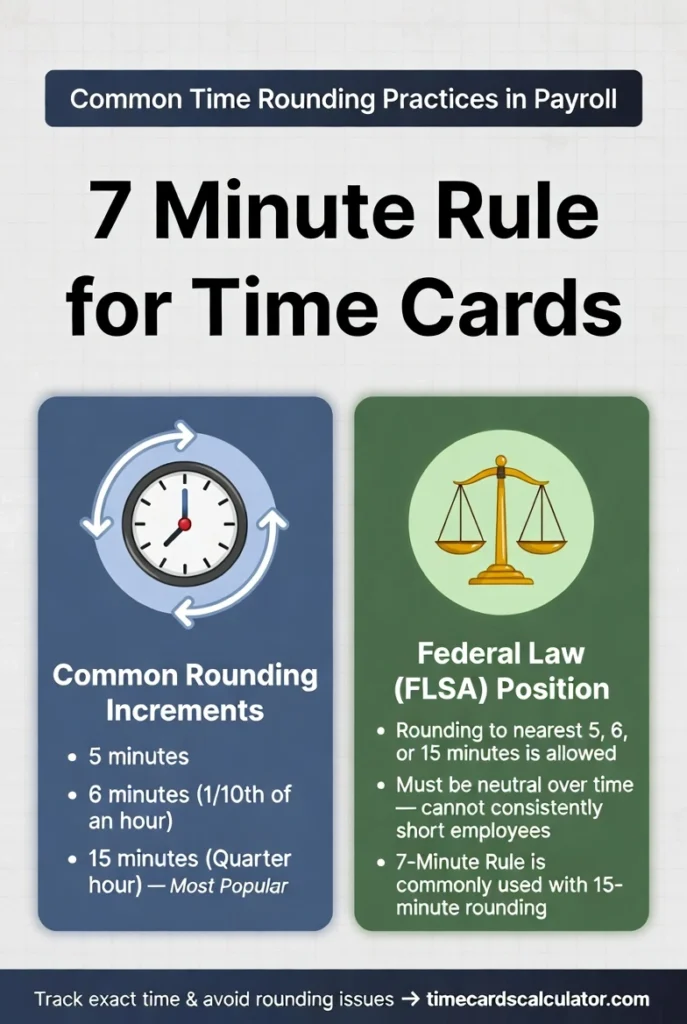
Under federal law, employers may round employee time to the nearest 5, 6, 10, or 15 minutes, but only if the rounding averages out over time so employees are fully compensated for all hours actually worked.
15-Minute Rounding (The 7 Minute Rule)
The most widely used method. Each punch rounds to the nearest quarter-hour.
| Clock-in Time | Rounds To |
| 9:00 to 9:07 | 9:00 |
| 9:08 to 9:14 | 9:15 |
| 9:15 to 9:22 | 9:15 |
| 9:23 to 9:29 | 9:30 |
The maximum adjustment per punch is 7 minutes. Rounding to a larger increment is a violation — if an employee clocks in at 8:12, the correct rounded time is 8:15, not 8:30.
6-Minute Rounding (Tenth of an Hour)
Each hour is divided into ten 6-minute segments. Time rounds to the nearest tenth of an hour, producing clean decimal values like 0.1, 0.2, 0.3. Common in call centers, law firms, and professional services where billing requires precise decimal hours.
| Clock-in Time | Rounds To | Decimal |
| 9:00 to 9:02 | 9:00 | 0.0 |
| 9:03 to 9:05 | 9:06 | 0.1 |
| 9:06 to 9:08 | 9:06 | 0.1 |
| 9:09 to 9:11 | 9:12 | 0.2 |
5-Minute Rounding
Times round to the nearest 5 minutes. The midpoint is 2.5 minutes — 9:01 and 9:02 round to 9:00, while 9:03 and 9:04 round to 9:05. Less common than 15-minute rounding but fully legal under FLSA when applied consistently.
The Neutrality Rule: The Most Important Concept
Rounding must be neutral, meaning it sometimes benefits the employer and sometimes benefits the employee, balancing out over time. A policy that looks fair on paper isn’t enough. The actual outcomes must be neutral. Courts look at real data, not just written rules.
This is where most employers get into trouble. A rounding policy that appears fair can still be illegal if it consistently produces the same outcome, less pay for employees.
| Compliant Example |
| Workers clock in and out at random times throughout each 15-minute window. |
| Sometimes they gain a few minutes, sometimes they lose a few. |
| Over weeks and months, the gains and losses balance out. |
| Non-Compliant Example |
| Workers arrive a few minutes early to prepare and clock out exactly at shift end. |
| Early arrivals get rounded away, but there’s nothing to round up at departure. |
| Employees systematically lose minutes every day, every week, every month. |
The regulation doesn’t require precision on every paycheck, but if rounding consistently underpays employees, the practice becomes unlawful even if the written policy looks neutral.
What Makes a Rounding Policy Illegal
Rounding practices that consistently favor the employer may violate the Fair Labor Standards Act. Here’s what courts have found unlawful:
Always Rounding Clock-in Times Up
If 9:07 always becomes 9:15 instead of 9:00, employees consistently lose pay at the start of every shift.
Always Rounding Clock-out Times Down
If 5:07 always becomes 5:00 instead of 5:15, employees lose pay at the end of every shift.
Rounding Only in One Direction
Any policy that rounds clock-ins up and clock-outs down every time, regardless of the minute, systematically underpays workers.
Rounding to Intervals Larger Than 15 Minutes
FLSA does not permit rounding to the nearest 30 minutes or hour. The maximum increment is 15 minutes.
Real Legal Consequences, What Happens When Rounding Goes Wrong
Time rounding violations result in significant settlements every year.
| Notable Settlements |
| • California healthcare chain: $4.2 million for systematic underpayment through rounding |
| • National retailer: $3.1 million for rounding meal periods |
| • Home Depot: revised nationwide rounding policy after class-action lawsuits (2023) |
The Home Depot case is instructive — the company agreed to pay non-exempt employees based on actual minute-by-minute time punches after California workers alleged they lost pay through the quarter-hour rounding system. Even large, sophisticated payroll operations aren’t immune when the data clearly shows systematic underpayment.
State Rules: Not Every State Follows Federal Law
Federal FLSA rules set the minimum standard. Some states go further and restrict or ban certain practices entirely.
California
California effectively bans meal period rounding. Employers cannot round meal break start and end times, actual minutes must be recorded precisely. For other punches, California courts apply strict neutrality scrutiny. Rounding policies that pass federal review have been struck down in California because real-world data showed consistent underpayment.
Washington
Washington state does not allow rounding when calculating lunch breaks, meal breaks, or rest breaks. Actual time must be used for all break periods.
New York
New York generally follows federal FLSA rounding rules but applies additional scrutiny to ensure neutrality in practice.
Always check your state’s specific rules before relying on a rounding policy. In states with strict labor laws, the safer approach is recording actual minutes worked.
How Rounding Affects Overtime Calculations
Time rounding and overtime interact in ways that can quietly cost workers real money over a full year.
| The Math Adds Up Fast |
| 25 minutes of lost pay per week × $18/hour = ~$390 lost per year |
| 200 employees × $390 = $78,000/year in potential wage violations |
| Source: Based on 15-minute rounding rounding down at both clock-in and clock-out |
There’s also an overtime angle: an employee on a 7:00 AM–3:30 PM schedule who clocks in 10 minutes early every day and out 7 minutes late may actually be entitled to overtime. If the employer rounds back a quarter hour each morning to 6:45 AM, those extra punches can push recorded hours past 40, creating an overtime obligation the employer may not even realize exists.
For Employees: How to Check If Your Rounding Is Fair
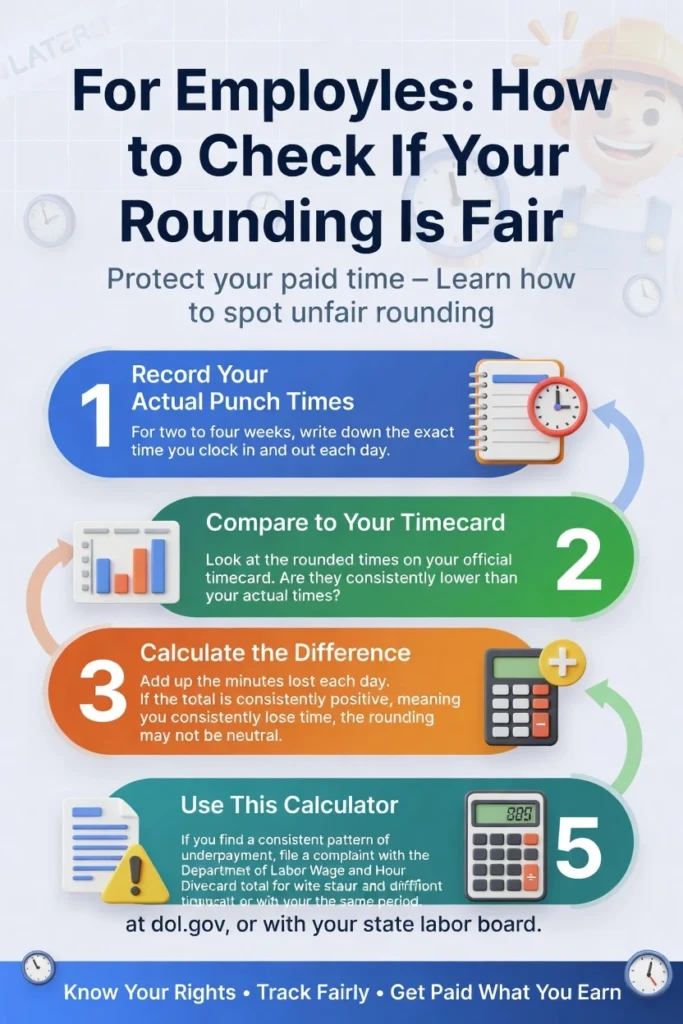
If you suspect your employer’s rounding policy is consistently costing you time, here’s how to check:
Step 1: Record Your Actual Punch Times
For two to four weeks, write down the exact time you clock in and out each day.
Step 2: Compare to Your Timecard
Look at the rounded times on your official timecard. Are they consistently lower than your actual times?
Step 3: Calculate the Difference
Add up the minutes lost each day. If the total is consistently positive, meaning you consistently lose time, the rounding may not be neutral.
Step 4: Use This Calculator
Enter your actual start and end times and compare the result to your official timecard total for the same period.
Step 5: Report If Needed
If you find a consistent pattern of underpayment, file a complaint with the Department of Labor Wage and Hour Division at dol.gov, or with your state labor board.
For Employers, How to Keep Your Rounding Policy Compliant
Document Your Policy Clearly
Put the rounding rules in writing. State exactly which increment you use, how the midpoint is calculated, and that the policy applies consistently to all employees. Keep both actual punch times and rounded times for every employee, and retain these records for at least three years.
Audit Regularly
Run a neutrality analysis at least monthly. Calculate the total minutes gained by employees versus total minutes lost due to rounding. If the balance consistently favors the employer, the policy needs adjustment.
Consider Removing Rounding Entirely
Modern time tracking software records exact minutes automatically. The original benefit of rounding was simplifying manual math, digital systems don’t need that shortcut. Employers who can track to the minute probably should. It eliminates compliance risk entirely.
Never Round Break Times
Rounding break times can violate both state and federal rules. Employees must be free from all work duties during breaks, tracking actual minutes is the only safe approach.
Does This Calculator Use Rounding?
Yes, but only when you choose it. This timecard calculator gives you full control over rounding settings:
- No rounding: Records exact minutes down to the actual punch time. Most accurate and safest from a compliance standpoint.
- 15-minute rounding (7 minute rule), Rounds each punch to the nearest quarter-hour using the standard FLSA method.
- 5-minute rounding: Rounds to the nearest 5 minutes.
- 6-minute rounding: Rounds to the nearest tenth of an hour for decimal-based payroll systems.
You can also choose to round only clock-ins, only clock-outs, or both. Whatever your workplace policy requires, the calculator matches it.
Frequently Asked Questions (FAQs)
Is the 7 minute rule required by law?
No. The FLSA permits 15-minute rounding, it doesn’t require it. Employers can also use 5-minute or 6-minute rounding, or record exact minutes. Many modern employers have moved to exact-minute tracking to avoid compliance risk.
Can my employer round only in their favor?
No. FLSA requires that rounding be neutral over time. A policy that consistently rounds clock-ins up and clock-outs down is not compliant, regardless of what the written policy says.
Does the 7 minute rule apply in California?
Partially. California applies stricter scrutiny to rounding than federal law. Courts have struck down rounding practices that passed federal standards when real data showed consistent underpayment. California also bans rounding for meal and rest break periods entirely.
What if my employer rounds to the nearest 30 minutes?
That’s not permitted under FLSA. The maximum rounding increment is 15 minutes. Rounding to 30 minutes or an hour violates federal law.
Can rounding affect whether I earn overtime?
Yes. If rounding consistently reduces your recorded hours, it could push you below the 40-hour overtime threshold in weeks where you actually worked more. This is one of the most common ways rounding violations affect workers.
How long must my employer keep timecard records?
Under FLSA, payroll records must be kept for at least 3 years. Time and work schedule records must be kept for at least 2 years.
Conclusion
The 7 minute rule is a simple concept but its impact on pay can quietly add up over time. Applied correctly and neutrally, rounding is a legal and practical way to manage timekeeping. Applied in a way that consistently favors the employer, it becomes wage theft and courts treat it exactly that way.
As an employee, understanding how your employer rounds your time gives you the tools to check your own paycheck. As an employer, regular audits and clear documentation are the difference between a compliant policy and an expensive lawsuit.
Use this timecard calculator to enter your actual punch times and see your exact hours, with or without rounding applied.
[ Use the Free Timecard Calculator ]
Related: Decimal Time Conversion | Exempt vs Non-Exempt | FLSA Federal vs California Overtime | Timesheet Templates