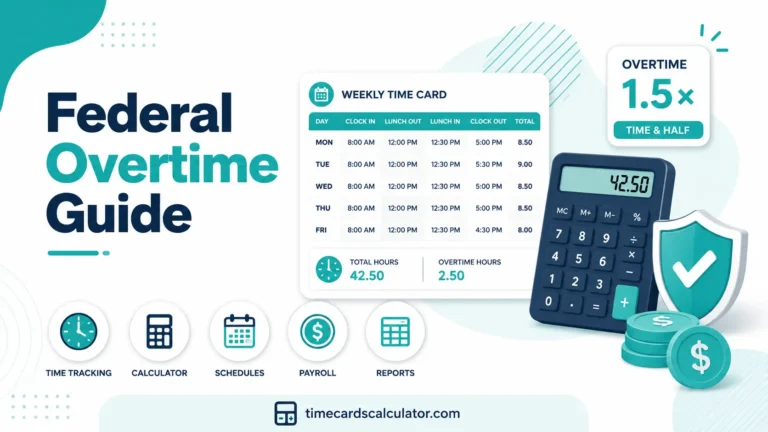
Ever wondered why some coworkers get overtime pay and others don’t, even when everyone’s putting in the same long hours? The answer almost always comes down to one thing: whether you’re classified as exempt or non-exempt under federal law.
This classification of exempt vs non-exempt directly affects your paycheck every single week. Once you understand which category you fall into, you’ll know exactly what you’re entitled to, and you’ll be able to catch errors before they cost you money.
Table of Contents
What Do Exempt vs Non-Exempt Actually Mean?
The Fair Labor Standards Act (FLSA) is the federal law governing minimum wage, overtime pay, and recordkeeping across the United States. Under the FLSA, every employee falls into one of two categories.
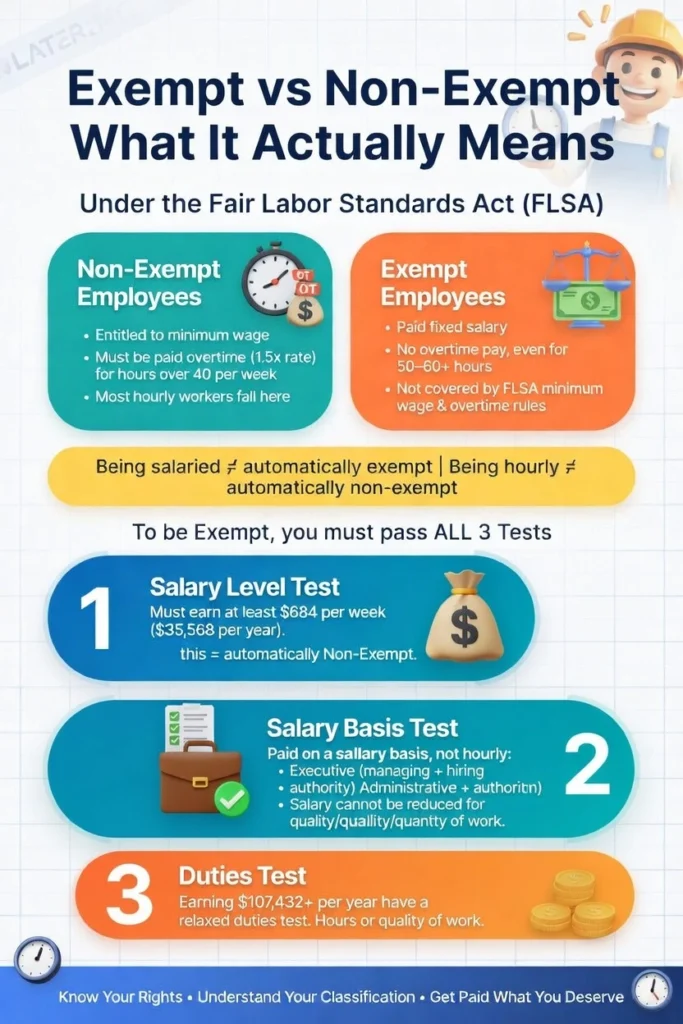
Non-exempt employees are covered by FLSA protections. They’re entitled to at least the federal minimum wage, and they must be paid overtime at 1.5 times their regular rate for every hour worked beyond 40 in a workweek. Most hourly workers in the U.S. fall into this category.
Exempt employees are not covered by FLSA overtime and minimum wage rules. They receive a fixed salary regardless of how many hours they work, no overtime, even if they’re regularly putting in 50 or 60 hours.
Here’s the part that trips people up: being salaried does not automatically make you exempt. And being paid hourly doesn’t automatically make you non-exempt. The classification exempt vs non-exempt depends on three specific tests, and you have to pass all three.
The Three Tests for Exempt Status
To qualify as exempt under the FLSA, an employee must pass all three of the following tests. Failing even one means the employee is non-exempt and entitled to overtime.
Test 1: Salary Level Test
As of May 2026, an employee must earn at least $684 per week ($35,568 per year) to qualify for most exemptions. This is the standard the U.S. Department of Labor formally confirmed through a technical amendment in May 2026, after a 2024 rule that would have raised the threshold was struck down in federal court.
If you earn below this amount, you’re automatically non-exempt, regardless of your job title or what your duties look like day to day.
Test 2: Salary Basis Test
The employee must receive a fixed, predetermined salary each pay period. That salary cannot be reduced because of variations in the quality or quantity of work performed.
Put simply: an exempt employee gets their full salary whether they work 35 hours or 55 hours in a given week. If your pay fluctuates based on hours worked, that’s a strong signal you’re non-exempt.
Test 3: Duties Test
The employee’s primary job duties must fall into one of the recognized exempt categories:
Executive exemption: Your main job is managing the business or a recognized department. You regularly direct at least two full-time employees and have real authority to hire, fire, or make meaningful personnel recommendations.
Administrative exemption: You perform office or non-manual work directly related to management or general business operations, and your role genuinely requires independent judgment and discretion on significant matters.
Professional exemption: Your work requires advanced knowledge in a field of science or learning, typically gained through prolonged specialized education. This covers roles like doctors, lawyers, engineers, and accountants.
Computer employee exemption: Applies to certain IT professionals including systems analysts, programmers, and software engineers, provided they meet the salary threshold.
Outside sales exemption: Applies to employees whose primary duty is making sales or obtaining orders away from the employer’s place of business.
Highly Compensated Employees
Employees earning $107,432 or more per year qualify as highly compensated employees (HCE) under the FLSA. For these workers, the duties test is relaxed, they only need to regularly perform at least one duty of an exempt executive, administrative, or professional employee to qualify.
Non-Exempt Employees, Your Rights
Minimum wage: Your employer must pay you at least the federal minimum wage for every hour worked. Many states set higher minimums, and wherever there’s a conflict, the higher rate applies.
Overtime pay: Any hour worked beyond 40 in a single workweek must be paid at 1.5 times your regular rate. This applies whether you’re paid hourly, by salary, by piece rate, or by commission.
Accurate time records: Your employer is legally required to track and maintain records of your hours worked. This is exactly why timecard accuracy matters so much for non-exempt workers.
Protection from pay docking: Your employer cannot reduce your pay below minimum wage, even through deductions.
Exempt Employees, What You Give Up
No overtime pay, You can work 50, 60, or 70 hours in a week and receive the same salary as a 40-hour week. There’s no legal requirement for additional compensation.
No minimum wage protection, Federal minimum wage rules don’t apply to exempt employees.
No limit on required hours, The FLSA doesn’t cap how many hours an employer can require an exempt employee to work in a week.
Time tracking may still happen, Even though the law doesn’t require it, many employers track exempt employee hours for project management or performance purposes.
State Laws Can Give You More
Federal FLSA rules are the floor, states can and often do go further.
California doesn’t recognize several of the FLSA’s exemptions, including the highly compensated employee and business owner exemptions. California also requires that exempt employees earn at least twice the California state minimum wage annually. As the state minimum wage rises, so does the exemption threshold automatically.
Colorado also sets its own salary threshold under the Colorado Overtime & Minimum Pay Standards (COMPS) Order, currently $1,111.23 per week ($57,784 per year) for 2026, well above the federal $684 minimum. This matters for exempt vs non-exempt classification because an employee who clears the federal threshold may still fall short of Colorado’s higher one. Colorado’s threshold rises automatically each January based on the state minimum wage.
Washington state has the highest exempt salary threshold in the country at $1,541.70 per week ($80,168.40 per year) for 2026, more than double the federal minimum. For exempt vs non-exempt purposes, this means an employee classified as exempt in most other states could be legally entitled to overtime in Washington. Washington’s threshold is tied to a multiplier of the state minimum wage and is scheduled to keep increasing through 2028.
Worth noting separately: a 2025 federal tax law (OBBBA) introduced a new deduction for overtime pay specifically for non-exempt workers. This is a tax change, not a change to who qualifies for overtime under the FLSA. See our No Tax on Overtime guide for the full breakdown of how the deduction works.
According to the New York State Department of Labor, New York has higher salary thresholds than federal law. As of January 1, 2026, exempt employees in New York City, Nassau, Suffolk, and Westchester counties must earn at least $1,275 per week ($66,300 per year) to qualify for administrative and executive exemptions. The rest of New York State has a lower threshold of $1,199.10 per week ($62,353.20 per year).
The general rule: when federal and state laws conflict, the law most favorable to the employee applies. Always check your state’s labor laws alongside the FLSA.
Common Misclassification Mistakes
when it comes to exempt vs non-exempt job title doesn’t equal exempt status. Calling someone a “manager” or “supervisor” doesn’t automatically make them exempt. If they’re spending more than 50% of their time doing the same tasks as the hourly workers they supervise, they may still be entitled to overtime, title and all.
Salary alone isn’t enough. Paying someone a salary puts them on the path to exempt status, but they still have to pass the duties test. A salaried warehouse worker is almost certainly non-exempt.
Part-time salaried employees: A part-time employee paid a salary may still be non-exempt if their salary falls below the weekly threshold when calculated properly.
Independent contractors are a different category. The FLSA doesn’t cover independent contractors. But California’s AB5 law sets strict standards for who can legitimately be classified as a contractor. Misclassifying employees as contractors to avoid overtime obligations carries serious legal exposure.
What Happens When Employees Are Misclassified?
Back pay: The employer owes unpaid overtime for the entire period of misclassification, which can stretch back years.
Liquidated damages: Courts can double the back pay award as an additional penalty.
Attorney fees: Employers typically pay the employee’s legal costs if the employee wins.
DOL investigation: The Department of Labor’s Wage and Hour Division investigates complaints and can audit an employer’s entire workforce, not just the person who filed.
If you believe you’ve been misclassified as exempt vs non-exempt classification, file a complaint with the DOL Wage and Hour Division at dol.gov or consult an employment attorney.
How to Check Your Own Classification for exempt vs non-exempt?
Work through these three questions to have a clear understanding:
1. Am I paid a fixed salary of at least $684 per week ($35,568)?
2. Does my salary stay the same regardless of how many hours I work in a week?
3. Do my primary job duties involve managing people, making significant business decisions, or specialized professional work requiring advanced education?
If you answered no to any of these, you’re likely non-exempt, meaning overtime rules apply to your hours.
When in doubt, the DOL provides a free classification review at dol.gov. You can also ask your HR department to show you the exemption determination for your specific role if you have any ambiguity for exempt vs non-exempt classification.
Exempt vs Non-Exempt – Quick Reference
The table below summarizes how the exempt vs non-exempt salary threshold compares across the states covered on this page.
| Non-Exempt | Exempt | |
|---|---|---|
| Overtime after 40 hours | Yes — 1.5x pay | No |
| Minimum wage protection | Yes | No |
| How they’re paid | Hourly or salary | Salary only |
| Salary threshold (2026) | Below $684/week | At least $684/week |
| Time tracking required | Yes, by law | Not required by FLSA |
| California daily overtime | Yes, after 8 hours | No |
| Who qualifies | Most hourly workers | Managers, professionals, some IT |
State Salary Thresholds at a Glance (2026)
| State | Weekly Threshold | Annual Equivalent |
|---|---|---|
| Federal (FLSA baseline) | $684 | $35,568 |
| Colorado | $1,111.23 | $57,784 |
| California | $1,352 | $70,304 |
| New York (NYC & downstate) | $1,275 | $66,300 |
| Washington | $1,541.70 | $80,168.40 |
How This Connects to Your Timecard
For non-exempt employees, every hour on the clock counts toward overtime. A timecard calculator helps you track daily and weekly hours accurately, spot exactly when overtime thresholds are reached, verify your paycheck matches your actual hours, and keep records you can reference if a pay dispute comes up.
For workers in California, daily overtime after 8 hours makes accurate daily tracking especially important, not just watching your weekly total.
Frequently Asked Questions (FAQs)
Can a salaried employee be non-exempt?
Yes, salary alone doesn’t determine exempt status. A salaried employee who earns below $684 per week, or whose duties don’t meet the exemption tests, is non-exempt and fully entitled to overtime pay.
Can my employer change my classification?
Yes. Employers can reclassify employees as long as the new classification is correct under FLSA rules. What they cannot do is reclassify you simply to avoid paying overtime you’ve already earned.
What if I work in California?
California has stricter rules. The state doesn’t recognize some federal exemptions, the salary threshold is tied to the California minimum wage, and daily overtime after 8 hours applies to all non-exempt workers. See the California Overtime Calculator guide for full details.
Is a manager always exempt?
Not automatically. A manager must pass the duties test, meaning their primary duty is actually managing people and making real personnel decisions, not just doing the same work as the team they oversee.
Does overtime apply to part-time workers?
Yes. Part-time non-exempt employees are entitled to overtime for any hours worked beyond 40 in a workweek, same as full-time workers. Working part-time doesn’t change the 40-hour threshold.
Did the federal salary threshold change in 2026?
It changed back. The DOL had planned to raise it to $1,128 per week starting January 2025, but a federal court vacated that rule in late 2024. The DOL formally confirmed the lower $684 per week threshold in a May 2026 technical amendment, so $684 is the current, enforceable federal standard going into the rest of 2026.
Which states have the highest exempt salary thresholds?
As of 2026, Washington has the highest at $1,541.70 per week, followed by California at $1,352 per week, New York at up to $1,275 per week depending on region, and Colorado at $1,111.23 per week. All four exceed the federal minimum of $684 per week, and employers in those states must use the higher state figure when making the exempt vs non-exempt determination.
Conclusion:
Your exempt vs non-exempt classification is one of the most consequential factors in how your pay gets calculated. It determines whether overtime applies, whether your hours need to be tracked, and what protections you have under federal and state law.
The rules are straightforward once you know the three tests: salary level, salary basis, and duties. Pass all three, and you’re likely exempt. Fail any one of them, and overtime protections apply to your hours, regardless of what your employer calls you.
[Use the Free Timecard Calculator]
Related: California Overtime Rules | Federal vs California OT | Timesheet Templates | 7 Minute Rule Explained | No Tax on Overtime