
Free & Accurate California Overtime Calculator 2026
Quick Answer: California Overtime law requires 1.5x pay after 8 hours in a single workday, not just after 40 weekly hours like federal FLSA. Hours beyond 12 in one day earn 2x pay. The 7th consecutive workday also triggers overtime from the first hour worked, regardless of weekly total.
Let’s get one thing straight: California overtime law is not like what most people learn from HR orientation. Most U.S. states stick to the federal playbook, work more than 40 hours in a week, get paid 1.5x for the extra. Simple enough.
California threw that playbook out.
Here, overtime can kick in after a single long day, even if your total for the week never gets close to 40 hours. If you work in this state and you’re not watching your daily hours, there’s a real chance you’re leaving money behind every single pay period.
This California overtime calculator runs the numbers for you. Plug in your hours and your pay rate, and it’ll break everything down, regular pay, overtime, double time, all in one shot.
Table of Contents
Why California Overtime Hits Different
The Fair Labor Standards Act sets the baseline for the whole country: 40 hours a week, then 1.5x kicks in. One rule. One number.
California built something more complicated on top of that. The California Labor Code, combined with the Industrial Welfare Commission Wage Orders, adds a whole layer of daily overtime rules that run independently from the federal weekly standard. So, you could work a totally normal 38-hour week and still be owed California overtime, because one of your days ran to 10 or 11 hours.
That’s the part most people miss. And it’s also the part most worth knowing.
California Overtime Rules, Full 2026 Breakdown
The rules below are based on guidelines from the California Department of Industrial Relations and align with federal standards. Let’s have a closer look at how these rules work in practice:
Daily Overtime: The One That Catches People Off Guard
Hours 1–8 each workday: Regular pay. Nothing unusual.
Hours 9–12 on any single workday: This is where it changes. Any time past 8 hours in one day gets paid at 1.5x your regular rate, regardless of your weekly total. You could have worked a light Tuesday and Wednesday. Doesn’t matter. Thursday goes to 10 hours, Thursday has overtime.
Hours beyond 12 in a single workday: Now you’re in double-time territory. Every hour past the 12-hour mark pays at 2x. Federal law doesn’t have anything like this. It simply doesn’t exist at the federal level.
Weekly Overtime
Past 40 straight-time hours in a workweek: The first 8 hours of each day are what count toward your weekly total. Once those stack up past 40, the overflow becomes overtime at 1.5x.
Worth knowing: the daily overtime hours you already earned don’t also count toward the weekly 40. That would be double-counting, and California specifically prohibits it, it’s called the anti-pyramiding rule.
The 7th Consecutive Day Rule
Work 7 days straight in the same workweek? Day 7 has its own rules, completely separate from everything else.
First 8 hours on day 7: Overtime at 1.5x, from the very first hour, no matter how few total hours you’ve worked that week. Past 8 hours on day 7: Double time.
One thing that trips people up: even clocking a few minutes on a day counts as “working that day.” There’s no minimum threshold. Show up, it counts.
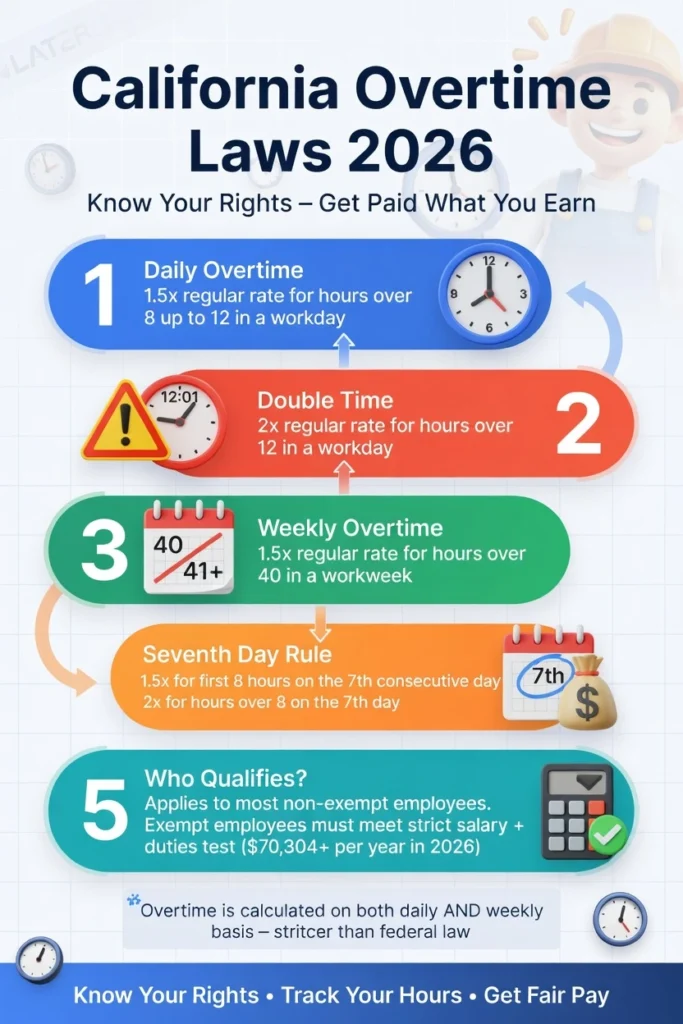
At a Glance
| Situation | Pay Rate |
|---|---|
| First 8 hours each workday | Regular (1x) |
| Hours 9–12 on any workday | Overtime (1.5x) |
| Past 12 hours on any workday | Double time (2x) |
| Past 40 straight-time hours in a week | Overtime (1.5x) |
| First 8 hours on 7th consecutive workday | Overtime (1.5x) |
| Past 8 hours on 7th consecutive workday | Double time (2x) |
2026 Numbers
California updates its labor law figures every January 1. Here’s what’s current:
| 2026 | |
|---|---|
| Statewide minimum wage | $16.90/hour |
| Overtime minimum (1.5x) | $25.35/hour |
| Exempt salary threshold | $1,352/week — $70,304/year |
| Computer software exemption | $58.85/hour — $122,573/year |
| Fast food workers | $20.00/hour |
| Healthcare workers | $18–$25/hour (phased rollout) |
Quick note on cities: San Francisco, Los Angeles, and several others have set their own local minimums above the statewide rate. The local number is what applies, not the statewide one. And that higher local minimum also bumps up what counts as the exempt salary threshold in that city.
Let’s Walk Through Some Real Numbers
Let`s understand this with example of shifts and different work hours:
Example 1: One Long Monday Changes Everything
Maria’s in San Diego, making $20/hour. Monday she works 10 hours, then 7 hours each day Tuesday through Friday. That’s 38 hours total for the week.
Federal law sees 38 hours and calls it a day. Regular pay all around. Maria takes home $760.
California sees it differently. Monday’s first 8 hours: $160. Hours 9 and 10 on Monday at 1.5x: $60. The rest of the week, 28 hours at $20: $560. Total: $780.
Twenty dollars more, on a week that never hit 40 hours.
Example 2: The 14-Hour Shift
James is in Los Angeles at $25/hour. One Thursday, he pulls a 14-hour shift and 7th day rule;
| Hours | Type | Rate | Earned |
|---|---|---|---|
| Hours 1–8 | Regular | $25.00 | $200 |
| Hours 9–12 | Overtime (1.5x) | $37.50 | $150 |
| Hours 13–14 | Double time (2x) | $50.00 | $100 |
| Total | $450 |
Under just the federal rules, that same shift pays $425. The double-time rule added $25. Doesn’t sound like much on one shift, but longer shifts and more of them, and it adds up fast.
Example 3: Working All 7 Days
Priya’s in Sacramento, $18/hour, 8 hours a day, all 7 days. 56 hours for the week.
Monday–Friday, 40 hours regular: $720. Saturday, day 6, weekly overtime at 1.5x: $216. Sunday, the 7th consecutive day, first 8 hours automatically at 1.5x: $216. Weekly total: $1,152.
The 7th-day rule guarantees Priya gets 1.5x from the very start of Sunday, regardless of everything else. That protection exists specifically because of California law.
Who Does This Actually Cover?
California’s overtime rules apply based on where the work happens, not where the company is based or where the employee lives when they’re not working.
Covered: Most hourly workers in California. Salaried employees under $1,352/week who don’t pass the duties test. Part-time hourly workers, daily overtime applies even on light weeks. Remote workers physically doing their work in California. Employees of out-of-state companies as long as the work is performed in California. Agricultural workers at all California employers, including small farms, this changed in January 2025.
Exempt: Salaried employees above $1,352/week who pass the duties test. Computer software professionals at $58.85/hour or above. Outside salespersons. Legitimate independent contractors, though California AB5 makes classification genuinely difficult.
On nurses: California Labor Code explicitly says registered nurses cannot be exempt from overtime, no matter their salary. RNs get the full daily and weekly protections. No exceptions.
Breaks, California Has Rules Here Too
Meal Breaks
Any shift longer than 5 hours requires a 30-minute unpaid meal break. Over 10 hours? A second one is required. Miss one? The employer owes an extra hour of pay at the regular rate, premium pay, per missed break.
Meal breaks are unpaid. Take them out of your hours before entering anything into the calculator.
Rest Breaks
10-minute paid rest break for every 4 hours worked. Can’t be waived. Miss one, and that’s another hour of premium pay owed.
Rest breaks are paid time, they stay in your hour count.
Alternative Workweek Schedules
There is a way to legally work more than 8 hours a day without triggering daily overtime. It requires a formal Alternative Workweek Schedule, not just an agreement, but an actual vote. Two-thirds of affected employees need to approve it by secret ballot, and the results have to be filed with the California DLSE.
The most common version is a 4/10, four days at 10 hours each. Daily California overtime overtime starts after the scheduled shift length rather than after 8 hours. Double time still applies past 12, and the 40-hour weekly threshold still stands.
What doesn’t work: any informal “let’s just agree to skip the overtime” conversation. Those arrangements aren’t enforceable under California law, regardless of what anyone signed.
Mistakes That Cost People Money
Watching only the weekly total. Daily overtime doesn’t care how your week adds up. One long day is all it takes.
Forgetting the 7th-day rule. Employees working 6-day weeks sometimes don’t realize that adding even a short Sunday shift triggers California overtime from the very first minute. Wage claims over this come up constantly.
Subtracting rest breaks from hours. Rest breaks are paid work time. Taking them out understates hours and shortchanges pay.
Assuming salary means exempt. It doesn’t, not on its own. California requires the salary to be above $1,352/week AND the job duties to qualify.
Averaging across multiple weeks. California doesn’t allow it. Each workweek is evaluated on its own.
If You Think You’re Owed Unpaid California Overtime
DLSE wage claim, The Division of Labor Standards Enforcement takes online complaints at dir.ca.gov. No cost to file. If they find a violation, they can order back wages, interest, and penalties.
Civil lawsuit, California courts allow recovery of unpaid wages, interest, attorney fees, and additional penalties.
Class action, If multiple employees have been affected by the same practice, a class action may already be in progress. You don’t have to file individually.
Time limits: Wage claims generally have a 3-year window. Under California’s Unfair Competition Law, it can extend to 4 years. Don’t assume you’ve waited too long without checking.
Exempt vs. Non-Exempt Employees & California overtime
California’s overtime rules, daily overtime after 8 hours, double time after 12, and the 7th consecutive day rule, only apply to non-exempt employees. Exempt employees, typically salaried workers in executive, administrative, or professional roles who meet California’s minimum salary threshold, are not entitled to overtime pay regardless of how many hours they work.
The distinction matters because misclassification is one of the most common wage disputes in California. An employee paid a salary isn’t automatically exempt, the role has to meet specific duties tests under California Labor Code, not just a pay structure. If you’re tracking hours for a team with both exempt and non-exempt staff, our HR & Payroll Timesheet Template and Exempt Employee Timesheet Template handle each group correctly, the non-exempt template calculates overtime automatically, while the exempt template tracks attendance without applying overtime formulas. California Overtime
Frequently Asked Questions (FAQs)
I work from home. Does California overtime still apply to me?
Yes. The California overtime rules follow where the work is performed, not where your employer is located. Sitting in California doing your job means California overtime law covers you.
My title says ‘manager.’ Am I automatically exempt?
No. The executive exemption requires that managing employees is actually your primary job, more than half your working time. If you’re mostly doing the same tasks as the people you technically supervise, the title doesn’t create the exemption.
Can my employer give me compensatory time instead of paying overtime?
In most private-sector jobs, no. Compensatory time off in place of cash overtime is generally reserved for government employers. Private employers have to pay.
I signed something agreeing to straight time for California overtime. Does that hold up?
No. California Labor Code Section 1194 makes any agreement to waive overtime pay void and unenforceable. You can’t sign away that right.
What about commission-based pay?
Overtime still applies. The regular rate is calculated using total weekly earnings, commissions included, divided by hours worked. The overtime premium applies on top of that.
What if I’m paid by the piece?
Same idea. California requires piece-rate workers to receive overtime at the applicable thresholds. The employer calculates your effective hourly rate and pays the overtime premium accordingly.
How is a workweek defined?
Any fixed, recurring 7-consecutive-day period the employer establishes. Once it’s set, it has to stay consistent. Shifting it to avoid triggering overtime isn’t allowed.
Is overtime taxed differently than regular pay in California?
No. Overtime pay is taxed the same as regular wages, there’s no special “overtime tax rate.” However, overtime can push your total paycheck into a higher tax withholding bracket for that pay period because the IRS withholding tables are based on the size of each paycheck. This often makes a paycheck with overtime feel like it’s taxed more heavily, but it evens out when you file your annual tax return, since your actual tax liability is based on total annual income, not per-paycheck amounts.
What is the difference between qualified and non-qualified overtime?
This isn’t a standard legal or payroll term, overtime under the FLSA and California law is either “exempt” (not eligible for overtime pay) or “non-exempt” (eligible for overtime pay at 1.5x or 2x the regular rate). If you’re seeing “qualified vs non-qualified” used elsewhere, it likely refers to this exempt/non-exempt distinction, or in some cases to whether specific bonus or commission pay must be included when calculating an employee’s “regular rate” for overtime purposes, since California requires certain non-discretionary bonuses to be factored into overtime calculations.
How do I claim overtime on my taxes?
You don’t claim overtime separately on your taxes, it’s included as part of your total wages on your W-2 and taxed at your normal income tax rate. There’s no separate overtime tax form or deduction. If your employer didn’t pay you overtime you were owed, that’s a wage claim issue, handled through the California Labor Commissioner’s Office, not a tax filing issue.
One More Thing Before You Calculate
California’s overtime rules offer more protection than the federal standard, but only for workers who actually know what they’re owed. The daily 8-hour threshold, double time after 12, and the 7th-day rule are easy to miss if you’re only keeping an eye on your weekly total.
Enter your hours and pay rate below. The California overtime calculator handles all of it, daily thresholds, double time, the 7th-day rule, and weekly overtime, and gives you a clear breakdown of regular pay, overtime pay, and your gross total.
[Calculate Your California Overtime Now →]
Related: Free Time Card Calculator | Timesheet Templates | FLSA Exempt vs Non-Exempt | 7 Minute Rule Explained | Time Card for Multiple Employees