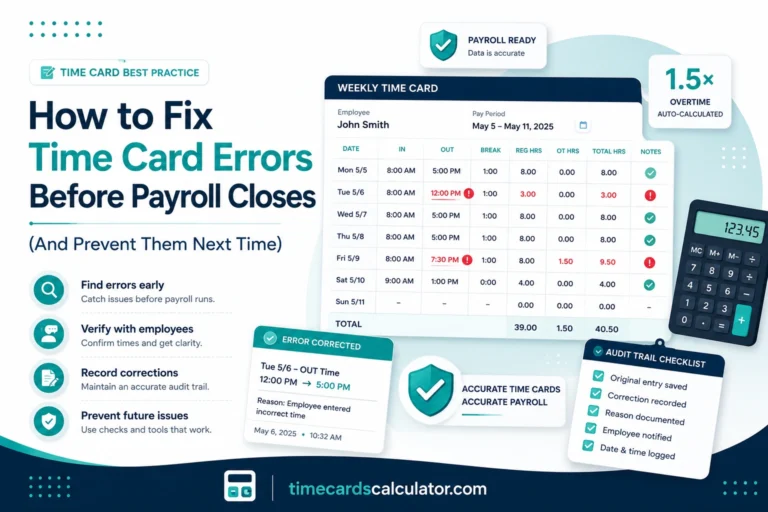
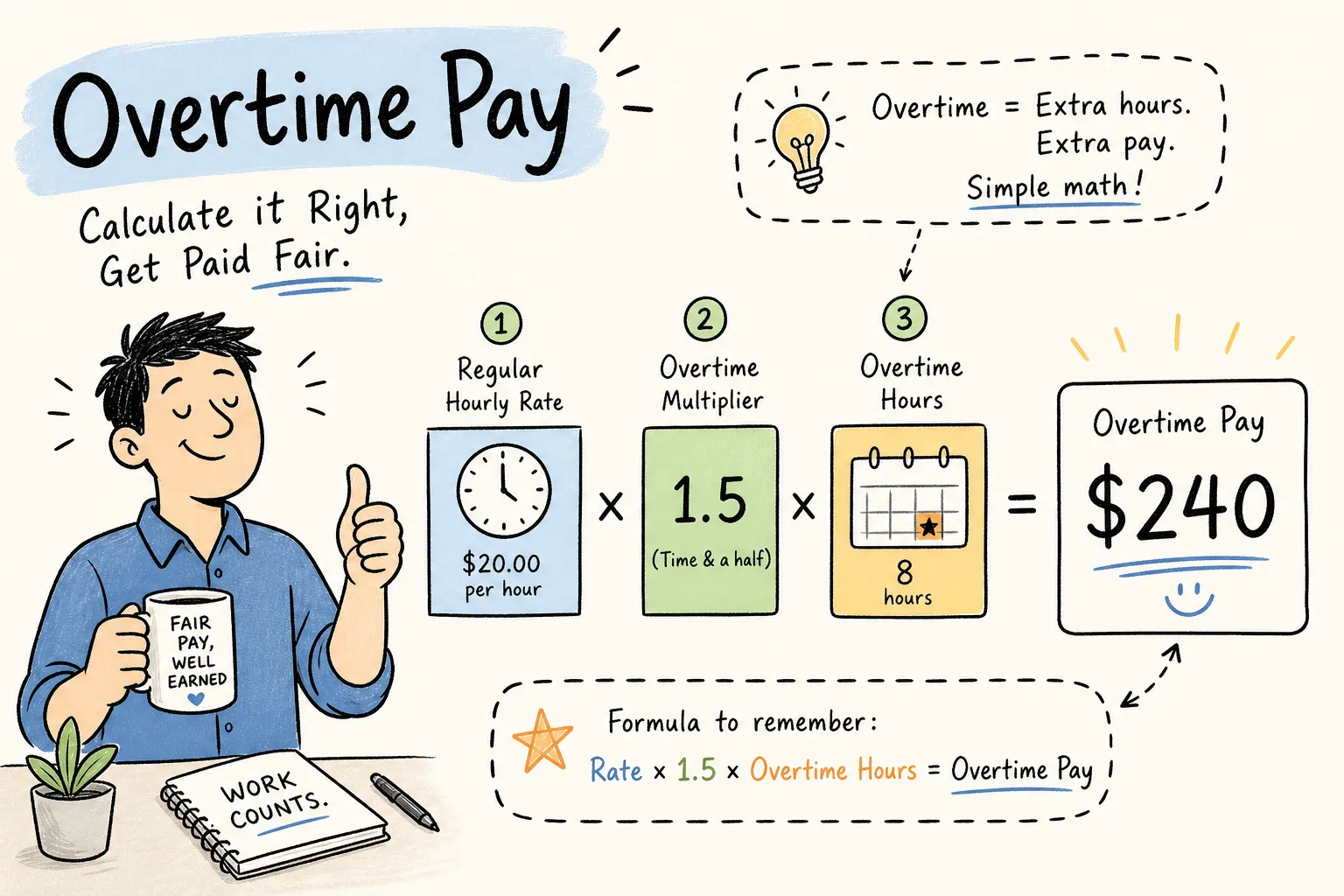
Quick Answer: To calculate overtime pay, multiply the employee’s regular hourly rate by 1.5 (time and a half), then multiply by hours worked beyond 40 in a workweek. At $18/hour for 50 hours: regular pay = 40 × $18 = $720; overtime rate = $18 × 1.5 = $27; overtime pay = 10 × $27 = $270; total gross pay = $990. Salaried workers & employees with bonuses need a slightly different approach, both covered below.
How to calculate overtime pay when It is the end of the pay period?
Your employee logged 52 hours. There’s a shift differential in the mix, and one of your workers is based in California. Suddenly the math isn’t simple anymore & the stakes are real. Underpay & you face a wage & hour claim. Overpay because the formula was wrong & you’ve handed money away for nothing.
The Department of Labor’s Wage and Hour Division recovered over $226 million in back wages from employers in a single recent fiscal year. Most of those errors came down to one thing: using the wrong overtime formula for the situation in front of them.
A flat hourly worker, a salaried non-exempt employee, and an employee with a nondiscretionary production bonus each require a different calculation. This guide walks through the exact math for each one, with real numbers, federal & state rules, and includes a free tool to calculate overtime pay automatically, without worrying about the tricky edge cases.
Table of Contents
How to Calculate Overtime Pay Under Federal Law (FLSA)
The Fair Labor Standards Act (FLSA), originally enacted in 1938 and still the governing federal law, sets the baseline every US employer works from. No state can offer workers less protection than the FLSA, states can only go further.
The 40-Hour Threshold and Time and a Half
Under the FLSA (29 CFR 778.107), any non-exempt employee who works more than 40 hours in a single workweek must be paid an overtime premium. A workweek is defined as any fixed, recurring 168-hour period, seven consecutive days. It doesn’t have to match the calendar week.
The required overtime rate is 1.5 times the employee’s regular rate of pay, commonly called “time and a half.” One thing that surprises many employers: the FLSA does not require overtime just because someone works nights, weekends, or holidays. Those hours only trigger time and a half when the weekly total crosses 40.
Who Qualifies? Non-Exempt Employees and the 2026 Salary Threshold
Overtime eligibility comes down to whether an employee is exempt or non-exempt. Under the Department of Labor’s current rule (in effect as of 2026), an employee must earn at least $684 per week ($35,568/year) to qualify as exempt under executive, administrative, or professional categories. Below that threshold, the employee is non-exempt regardless of job title, and time & a half applies.
Most hourly workers are non-exempt by default. Not sure which category applies? See our full guide: Exempt vs Non-Exempt Employees — What It Means for Your Pay.
How to Calculate Overtime Pay for Hourly Employees
For most workers, this is the scenario that applies: a set hourly rate, a timesheet showing more than 40 hours, and a paycheck that needs to reflect both. The math is straightforward once you know the three numbers involved, your hourly rate, your total hours, and the 40-hour cutoff. Here’s exactly how to run it.
The Basic Time and a Half Formula (Step by Step)
- Find the employee’s regular hourly rate
- Multiply by 1.5 → this is the overtime (time and a half) rate
- Subtract 40 from total hours worked → these are the overtime hours
- Multiply overtime rate × overtime hours = overtime pay
- Add regular pay (40 hrs × rate) + overtime pay = total gross wages
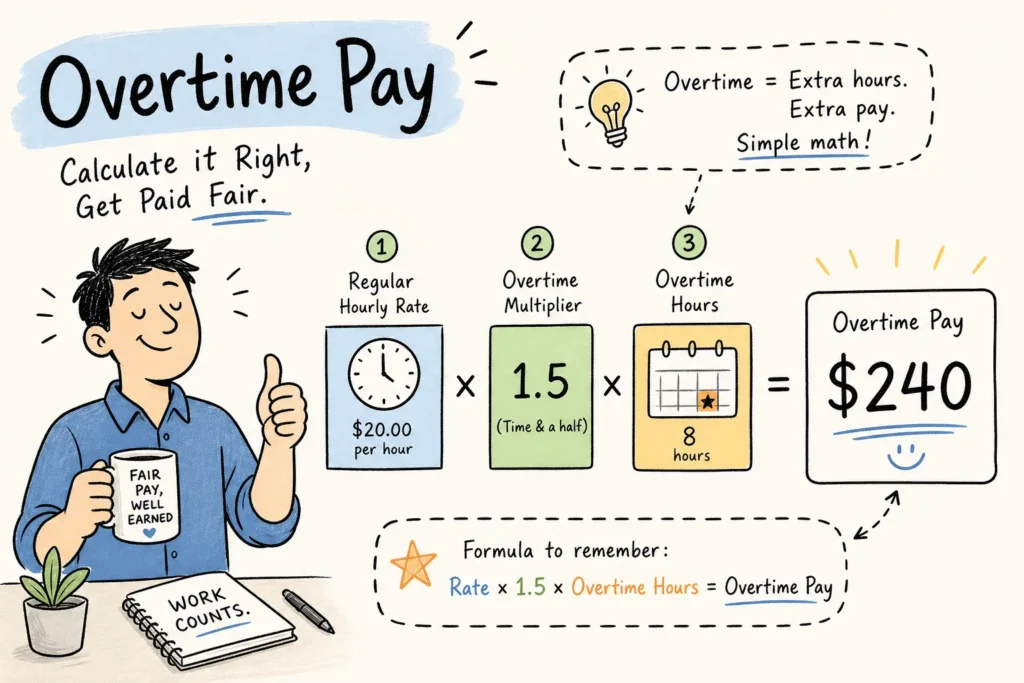
Overtime pay formula: (Hourly rate × 1.5) × overtime hours
Example: 50-Hour Workweek at $18/Hour
| Component | Calculation | Amount |
|---|---|---|
| Regular pay (40 hrs) | 40 × $18.00 | $720.00 |
| Time and a half rate | $18.00 × 1.5 | $27.00/hr |
| Overtime hours | 50 − 40 | 10 hrs |
| Overtime pay | 10 × $27.00 | $270.00 |
| Total gross pay | $720 + $270 | $990.00 |
When a Bonus Changes the Overtime Rate
Here’s the one that trips up most payroll runs: nondiscretionary bonuses, production bonuses, attendance bonuses, shift differentials, must be folded into the regular rate before you apply the 1.5 multiplier. Under 29 CFR 778.208, you can’t just calculate time and a half on the base hourly rate when a bonus is in the picture.
- Add total straight-time wages (hours × hourly rate) + bonus amount
- Divide by total hours worked that week → this is the true regular rate
- Multiply true regular rate × 0.5 × overtime hours → overtime premium
- Add premium to the straight-time total → total gross pay
Example: $12/hour, 50-hour week, $100 production bonus
Straight-time total: (50 × $12) + $100 = $700
True regular rate: $700 ÷ 50 = $14.00/hr
Overtime premium: $14.00 × 0.5 × 10 OT hours = $70
Total gross pay: $700 + $70 = $770
Why 0.5 and not 1.5? Because straight-time pay for all 50 hours is already in the $700 base. You’re only adding the overtime premium, not recalculating the whole thing.
How to Calculate Overtime Pay for Salaried Employees
A salaried worker isn’t automatically overtime-exempt. They need to clear the $684/week threshold AND pass the FLSA’s duties test. If they don’t meet both, they’re salaried non-exempt, and time and a half still applies.
Step by Step: Salary to Overtime Pay
- Divide weekly salary by 40 → regular hourly rate
- Multiply by 1.5 → overtime (time and a half) rate
- Multiply overtime rate × hours worked beyond 40 → overtime pay
- Add to base weekly salary → total weekly pay
Biweekly Pay Period Example
One trap with biweekly payroll: overtime is always calculated per workweek, not across the full two-week period. You cannot average a heavy week and a light week, each stands alone.
| Step | Calculation | Result |
|---|---|---|
| Biweekly salary | Given | $1,600 |
| Weekly salary | $1,600 ÷ 2 | $800 |
| Regular hourly rate | $800 ÷ 40 | $20.00/hr |
| Time and a half rate | $20.00 × 1.5 | $30.00/hr |
| Week 1 overtime pay (10 hrs) | 10 × $30.00 | $300 |
| Week 1 total | $800 + $300 | $1,100 |
Which State Overtime Rules Override Federal Law?
The FLSA sets the floor. Some states have built stricter rules on top, and if you have employees there, applying only the federal formula is a compliance error that creates real back-pay exposure.
California Overtime: Daily Threshold, Not Just Weekly
California doesn’t wait for 40 hours. Overtime here kicks in after just 8 hours in a single workday, even if the weekly total never gets close to 40. Hours beyond 12 in a day pay at double time (2x). The 7th consecutive workday has its own rules on top of everything else.
The full California breakdown, daily thresholds, double time rules, 7th day rule, worked examples, and the free calculator, is all in our dedicated guide: California Overtime Calculator 2026 →
Other States With Daily Overtime or Different Thresholds
| State | Daily OT Trigger | Who It Covers |
|---|---|---|
| Alaska | After 8 hours/day | All non-exempt employees |
| Nevada | After 8 hours/day | Employees earning below 1.5× state minimum wage |
| Colorado | After 12 hours/day or 12 consecutive hours | Whichever period is longer |
| Oregon | After 10 hours/day | Mill, factory, manufacturing only |
| Kansas | No daily threshold | State weekly threshold is 46 hrs — federal 40-hr rule controls for most employers |
In every state with a daily threshold, run both the daily and weekly calculation and pay whichever yields more. The two calculations are independent — you don’t add them together.
Does the “No Tax on Overtime” Law Affect How You Calculate It?
The One Big Beautiful Bill Act, signed in 2025, allows eligible FLSA non-exempt workers to deduct a portion of overtime premium pay from federal taxable income for tax years 2025–2028. The deduction caps at $12,500 for single filers and $25,000 for joint filers.
Important: this is a tax deduction, not a change to how overtime pay itself is calculated. The formula, regular rate × 1.5 × overtime hours, hasn’t changed. The gross overtime amount is still the same. What changes is how much of it gets counted as federal taxable income on the employee’s return.
Full breakdown is available on our dedicated guide: No Tax on Overtime 2026 — What Every US Worker Needs to Know →
6 Overtime Calculation Mistakes That Cost Real Money
- Calculating time and a half on base rate when a bonus exists: The overtime premium must be based on the true regular rate, which includes the bonus. Skipping this step means underpaying every overtime hour in that week.
- Averaging two weeks on biweekly payroll: A 50-hour week and a 30-hour week don’t cancel out. Each workweek is evaluated on its own for overtime purposes, full stop.
- Applying only the federal formula to California workers: One long day in California can trigger daily overtime even when the weekly total is under 40 hours.
- Assuming salary means exempt: Salary must be above $684/week AND the job duties must qualify. Title doesn’t matter; duties do. See: Exempt vs Non-Exempt guide.
- Not deducting unpaid breaks before calculating: Under 29 CFR 785.18-19, unpaid meal breaks of 30+ minutes come out of hours before overtime is applied. Paid rest breaks under 20 minutes stay in. See how break deductions affect decimal time conversion.
- Inconsistent time rounding: Rounding must be neutral and can’t systematically benefit the employer over time. Details in our 7 Minute Rule guide.
Skip the Manual Math Entirely
The formulas above are doable once you know them. But running them manually for multiple employees, every week, across different states and pay types, that’s where small errors quietly add up into real wage claims.
Free Time Card Calculator handles federal and California daily overtime automatically, supports biweekly periods and multiple shifts, and exports results to CSV or PDF for payroll records. No signup, no cost. Calculate Your Overtime Now — Free →
Frequently Asked Questions (FAQs)
What is the overtime pay formula?
Overtime pay = regular hourly rate × 1.5 × hours worked beyond 40. This is also called time and a half. For a $20/hour employee working 45 hours: 5 OT hours × $30 = $150 overtime pay on top of $800 regular pay.
How do you calculate time and a half?
Multiply the regular hourly rate by 1.5. At $16/hour, time and a half is $24/hour. That rate applies to every hour worked beyond 40 in the workweek.
How do you calculate overtime for a salaried employee?
Divide weekly salary by 40 to get the regular hourly rate, then multiply by 1.5 for the overtime rate. A $600 weekly salary = $15/hour regular rate = $22.50 overtime rate for every hour beyond 40.
Does a bonus affect how overtime pay is calculated?
Yes. Nondiscretionary bonuses must be included in the regular rate before applying the 1.5 multiplier. Divide total weekly earnings (wages + bonus) by total hours to get the true regular rate, then calculate the overtime premium on that.
Is overtime calculated per day or per week?
Federally, per week — after 40 hours. California, Alaska, Nevada, and Colorado add daily overtime thresholds on top of that. In those states, a single long day can trigger time and a half even if the weekly total is under 40.
What is “no tax on overtime” and does it change the calculation?
The 2025 law allows eligible workers to deduct overtime premium pay from federal taxable income. It doesn’t change the overtime pay formula itself — gross pay is still calculated the same way. See our full No Tax on Overtime guide for details.
How does time rounding affect overtime calculations?
Rounded clock times feed directly into the overtime calculation. Under the FLSA, rounding must average out neutrally over time, it can’t consistently favor the employer. Our 7 Minute Rule guide covers how legal rounding works.
Related: Free Time Card Calculator | California Overtime Calculator | Exempt vs Non-Exempt Guide | Decimal Time Conversion | 7 Minute Rule | No Tax on Overtime 2026 | Free Timesheet Templates