
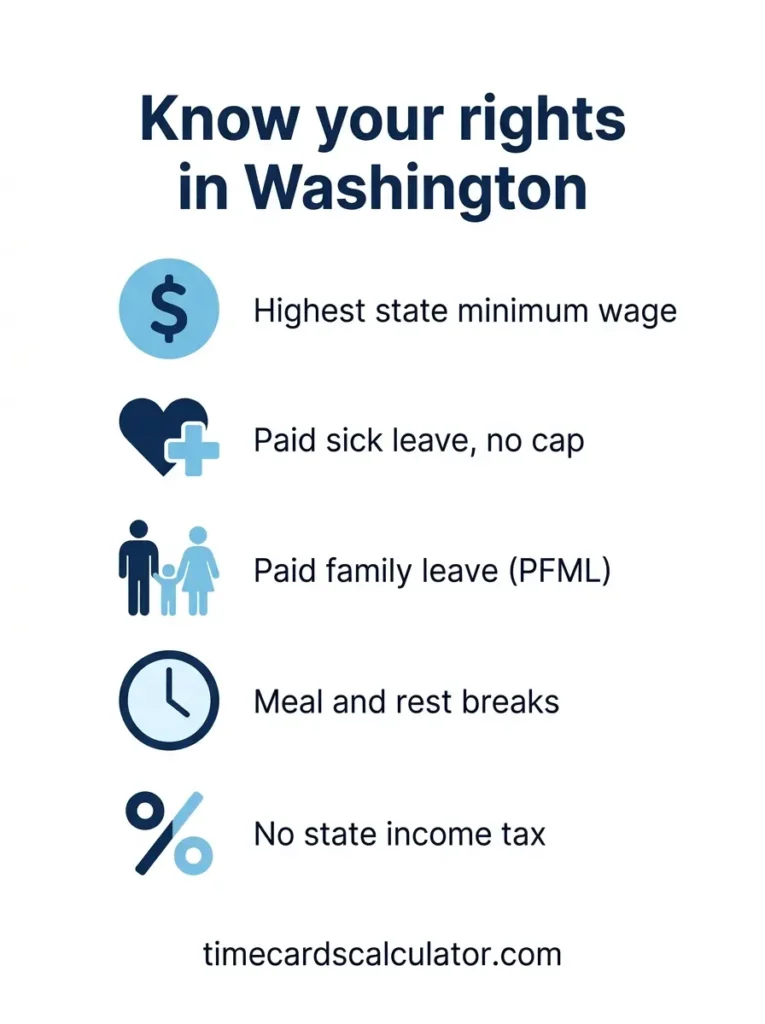
Quick Answer: Washington state labor laws for 2026 give workers some of the strongest protections in the country. The state minimum wage rose to $17.13 per hour on January 1, 2026, the highest in the nation, with several cities including Seattle setting even higher local rates. Overtime follows the federal 40 hour weekly rule at 1.5x pay, but Washington’s salary threshold for overtime exempt employees is far higher than federal law, $1,541.70 per week ($80,168.40 per year) in 2026. Employees get a paid 10 minute rest break every 4 hours and an unpaid 30 minute meal break during shifts over 5 hours. Nearly all employers must provide paid sick leave, accruing at 1 hour per 40 hours worked with no cap, and the state runs its own paid family and medical leave program (PFML) offering up to 12 weeks of paid leave.
Washington updates its labor numbers every January, the minimum wage, the overtime exempt salary threshold, and several local minimum wage rates all move at once, which makes this one of the more complicated states to keep up with if you’re running payroll. On top of that, Washington has no state income tax, which surprises people coming from other states and occasionally gets confused with labor law questions about pay.
This guide covers what changed for 2026 and the rules that matter most: minimum wage, overtime, exemptions, meal & rest breaks, paid sick leave, PFML, at will employment, and a few state specific quirks like the lack of income tax and how compressed workweeks fit into Washington’s overtime rules.
Table of Contents
Washington Minimum Wage 2026
As of January 1, 2026, Washington’s state minimum wage is $17.13 per hour for workers age 16 and older, an increase of 2.8 percent from 2025’s $16.66, based on the Consumer Price Index for Urban Wage Earners and Clerical Workers (CPI-W). This makes Washington’s minimum wage the highest of any state in the country.
Workers aged 14 and 15 can be paid 85 percent of the state minimum wage, which works out to $14.56 per hour in 2026. Washington also allows reduced rates in a few specific, certificate based situations, including on the job learners, student workers at qualifying schools, and apprentices in approved programs. Agricultural workers are not exempt and are entitled to the full minimum wage plus overtime after 40 hours per week.
Local Minimum Wage Rates
Several cities and one county set their own minimum wage higher than the state rate, and employers must pay whichever is higher. For 2026, this includes Seattle (rising to $21.30 per hour for most employers), along with Bellingham, Burien, Everett, Renton, SeaTac, Tukwila, and unincorporated King County. SeaTac also has a separate, even higher rate for hospitality and transportation workers. If you operate or work in one of these areas, the local rate is what applies, not the statewide $17.13.
Washington Overtime Law & the Exempt Salary Threshold
Washington follows the standard federal overtime rule for non-exempt employees: 1.5 times the regular rate for hours worked beyond 40 in a workweek. Washington does not require daily overtime or double time under state law, unlike Colorado or California, though some prevailing wage public works contracts may require it separately.
Where Washington differs sharply from federal law is in who counts as exempt from overtime in the first place.
The 2026 Exempt Salary Threshold
To be classified as overtime exempt under Washington law (the typical executive, administrative, or professional “white collar” exemptions), an employee must be paid a salary of at least 2.25 times the state minimum wage for a 40 hour week. For 2026, that works out to $1,541.70 per week, or $80,168.40 per year, regardless of employer size.
This is far above the federal threshold of $684 per week ($35,568 per year). The result: an employee earning between $684 and $1,541.70 per week is technically exempt under federal rules but not exempt under Washington rules. Since Washington law is more protective, the Washington threshold governs, and that employee is entitled to overtime pay under RCW 49.46.130.
The multiplier is increasing on a schedule set by L&I, from 2.0x in earlier years to 2.25x in 2026, heading toward 2.5x by 2028. This means the exempt salary threshold will keep climbing each year even beyond the annual minimum wage adjustment.
Computer Professionals
Washington has a separate exemption category for computer professionals, who can be classified as exempt either on a salary basis matching the standard threshold, or on an hourly basis at 3.5 times the minimum wage. For 2026, that hourly rate is $59.96.
If you’re tracking hours for employees near these thresholds, our free time card calculator can help confirm actual hours worked against the 40 hour weekly overtime trigger.
Washington Meal & Rest Break Laws
Washington requires both rest breaks and meal breaks for most non-exempt employees, and a 2024 court decision made the meal break rule noticeably stricter to enforce.
Rest Breaks
Employees are entitled to a paid 10 minute rest break for every 4 hours worked. Employers cannot require employees to work more than 3 consecutive hours without a break, and employees cannot be required to remain on site during rest breaks.
Meal Breaks
For shifts longer than 5 hours, employers must provide at least 30 minutes for a meal break, and that break must start between the second and fourth hour of the shift. Meal breaks are unpaid, unless the employer requires the employee to remain on duty or stay at the worksite during the break, in which case it must be paid.
The 2024 Penalty Pay Ruling
In Androckitis v. Virginia Mason Medical Center, the Washington State Court of Appeals held that employers who fail to provide a required meal break must pay the employee 30 minutes of penalty pay, separate from their regular wages for that time. This ruling effectively raised the cost of missed meal breaks and pushed many employers to tighten scheduling practices to make sure breaks are actually taken, not just offered on paper.
Washington Paid Sick Leave
Washington’s statewide paid sick leave law, in effect since 2018, requires nearly all employers to provide paid sick leave that accrues at 1 hour for every 40 hours worked, with no cap on how much can accrue and mandatory year to year carryover.
Paid sick leave can be used for the employee’s own health needs, to care for a family member (a definition that was broadened in 2025 to include people living in the employee’s home), for closures related to a public health emergency, and for domestic violence, sexual assault, or stalking related safety needs, a category expanded in 2026 to also include hate crime related leave.
The 2025 Separation Payout Change
A significant update took effect in 2025: employees who leave their job, even before completing 90 days of employment, must be paid out for accrued but unused sick leave (or PTO used to satisfy the sick leave requirement). Many employers had previously assumed no payout was owed if an employee left within that 90 day window, that assumption is no longer correct. Employers also cannot factor sick leave usage into attendance based discipline systems, including points based attendance policies.
Washington Paid Family & Medical Leave (PFML)
Washington runs its own state administered Paid Family and Medical Leave program through the Employment Security Department (ESD), separate from both paid sick leave and the federal FMLA.
Employees who have worked at least 820 hours in the qualifying period, roughly the past year, across any employer in Washington, are eligible. PFML provides up to 12 weeks of paid leave for bonding with a new child, the employee’s own serious health condition, caring for a family member with a serious health condition, or certain military related family needs. This can extend to 16 weeks if both medical and family leave are needed in the same year, or up to 18 weeks for pregnancy related complications.
PFML is funded through a payroll premium of 0.6 percent of gross wages, split between employers and employees, though employers with fewer than 50 employees aren’t required to pay the employer share, employees still qualify and contribute. Benefits are paid directly by the state, not the employer, replacing up to 90 percent of wages up to a weekly cap.
Starting in 2026, job protection under PFML extends to employers with 25 or more employees after just 180 days of employment, down from the previous 50 employee threshold, as part of changes under HB 1213.
Washington At Will Employment & Final Paycheck Rules
Washington is an at will employment state. Either the employer or employee can end the employment relationship at any time, for almost any reason, as long as the reason isn’t illegal, meaning not discriminatory or retaliatory.
When an employee’s job ends, whether they quit or are fired, Washington law requires final wages to be paid no later than the end of the established pay period in which the separation occurred. As noted above, this final payment must also include payout of any accrued, unused paid sick leave under the 2025 rule change.
Does Washington Have an Income Tax?
No. Washington is one of the small number of US states with no state income tax on wages, for anyone. This is sometimes confused with labor law questions because it affects take home pay, but it’s a tax policy issue, not a labor law one, and it has no effect on minimum wage, overtime, or leave entitlements. Washington funds state government primarily through sales tax and business taxes instead.
Compressed Workweeks & the 4 Day Work Week in Washington
Washington’s overtime law is based on a 40 hour workweek, not a daily hour cap, which means compressed schedules, like a 4 day work week with four 10 hour shifts, or a 9 day fortnight with longer days and an extra day off every two weeks, are generally workable under state law as long as total weekly hours don’t exceed 40 without triggering overtime.
That said, employers still must provide the required rest and meal breaks within each longer shift, a 10 hour shift, for example, would typically require more than one rest break under the “every 4 hours” rule. If you’re calculating pay for a 10 hour shift with a 30 minute lunch, or comparing a standard 5 day schedule against a compressed 4 day or 9 day fortnight schedule, our free time card calculator and timesheet templates can help you track actual hours against the 40 hour weekly threshold either way.
Noncompete Agreements in Washington
Washington restricts noncompete agreements to higher earning employees. For 2026, an employee must earn at least $126,858.83 in annualized total compensation, including salary, hourly pay, and commissions, for a noncompete to be enforceable against them. For independent contractors, the threshold is significantly higher, at least $317,147.09 in annualized compensation from the party seeking to enforce the agreement. Employees earning below these thresholds generally cannot be bound by a noncompete under Washington law.
Filing a Wage Complaint in Washington
If you believe you’ve been paid below minimum wage, denied required breaks, not paid for accrued sick leave on separation, or misclassified as exempt when you shouldn’t be, the Washington Department of Labor and Industries (L&I) handles wage complaints and investigations. L&I can order back payment of wages, including unpaid sick leave, and investigates both state minimum wage and overtime violations.
Washington vs. Federal Law: Quick Comparison
| Rule | Federal Standard | Washington Standard (2026) |
|---|---|---|
| Minimum wage | $7.25 per hour, fixed | $17.13 per hour, adjusts every January |
| Overtime threshold | Over 40 hours per week, 1.5x pay | Same, over 40 hours per week, 1.5x pay |
| Overtime exempt salary threshold | $684 per week ($35,568 per year) | $1,541.70 per week ($80,168.40 per year) |
| Meal break | Not required by federal law | 30 minutes unpaid, shifts over 5 hours |
| Rest break | Not required by federal law | 10 minutes paid, every 4 hours |
| Paid sick leave | Not required by federal law | 1 hour per 40 hours worked, no cap |
| Paid family leave | Unpaid only (FMLA), 50+ employees | Paid (PFML), available to nearly all employees |
| State income tax | N/A | None, Washington has no state income tax |
In Short
Washington combines the highest state minimum wage in the country with an overtime exempt salary threshold more than double the federal level, mandatory paid sick leave with no accrual cap, a state run paid family leave program, and no state income tax. If you’re an employer, the safest approach is checking both the state and any applicable local minimum wage, and confirming exempt employees actually clear the $1,541.70 weekly threshold, not just the federal one. If you’re an employee, knowing these baseline numbers helps you spot when something looks off on a paycheck or a job offer.
Frequently Asked Questions (FAQs)
What is the minimum wage in Washington for 2026?
Washington’s statewide minimum wage is $17.13 per hour as of January 1, 2026, for workers age 16 and older, the highest of any state. Workers aged 14 and 15 can be paid 85 percent of that rate, or $14.56 per hour. Several cities, including Seattle at $21.30 per hour, set their own higher local minimum wage, and employers must pay whichever rate is higher.
How is overtime calculated in Washington?
Washington follows the standard federal rule, non-exempt employees receive 1.5 times their regular rate for hours worked beyond 40 in a workweek. Washington does not have a daily overtime threshold like California or Colorado. What’s different is the salary level required to be exempt from overtime in the first place, which is much higher in Washington than under federal law.
What salary do I need to be overtime exempt in Washington?
For 2026, an employee must earn at least $1,541.70 per week, or $80,168.40 per year, to qualify for the standard white collar overtime exemptions, regardless of employer size. This is 2.25 times the state minimum wage for a 40 hour week. An employee earning less than this is entitled to overtime under Washington law even if their role would be considered exempt under the lower federal salary threshold.
Does Washington have an income tax?
No. Washington has no state income tax on wages for individuals. This is a tax policy matter, separate from minimum wage, overtime, or leave laws, and the state instead relies on sales and business taxes for revenue.
How does paid sick leave work in Washington?
Employees accrue 1 hour of paid sick leave for every 40 hours worked, with no cap on accrual and mandatory carryover year to year. It can be used for the employee’s own illness, to care for a family member, for public health emergency closures, or for domestic violence, sexual assault, stalking, or hate crime related safety needs. As of 2025, employees who separate from a job, even within their first 90 days, must be paid out for accrued unused sick leave.
What are Washington’s meal and rest break requirements?
Employees get a paid 10 minute rest break for every 4 hours worked, and cannot be required to work more than 3 consecutive hours without one. For shifts over 5 hours, employers must provide an unpaid 30 minute meal break starting between the second and fourth hour of the shift. If an employee must stay on duty during that break, it must be paid. A 2024 court ruling requires employers to pay a 30 minute penalty if a required meal break is missed.
What is Washington PFML and how is it different from regular sick leave?
PFML, Paid Family and Medical Leave, is a separate state run program through the Employment Security Department, offering up to 12 weeks (16 to 18 in some cases) of paid leave for serious health conditions, bonding with a new child, or caring for a family member. It’s funded by a small payroll premium and pays benefits directly from the state, unlike paid sick leave, which is provided and paid by the employer for shorter term needs. Employees need 820 hours worked in the qualifying period to be eligible for PFML.
Is Washington an at will employment state?
Yes. Either the employer or employee can end employment at any time, for almost any legal reason, or no reason. Upon separation, whether by quitting or termination, final wages, including any accrued unused sick leave, must be paid no later than the end of the established pay period in which the separation happened.
Can I work a 4 day work week or a 9 day fortnight in Washington?
Generally yes. Washington’s overtime rule is based on total hours in a 40 hour workweek, not a daily limit, so compressed schedules like four 10 hour days or a 9 day fortnight are workable as long as weekly hours stay at or under 40 without triggering overtime. Employers still need to provide the required rest and meal breaks within each longer shift.
Where do I file a wage complaint in Washington?
The Washington Department of Labor and Industries (L&I) handles complaints about unpaid wages, minimum wage violations, missed breaks, unpaid sick leave on separation, and misclassification as exempt. L&I can investigate and order back payment of wages owed.
Related Tools & Guides
- Free Time Card Calculator, calculate hours, breaks, and overtime against Washington’s 40 hour weekly threshold
- Colorado Labor Laws Guide 2026, compare Washington’s rules to Colorado’s daily overtime and leave laws
- Free Timesheet Templates, including templates suited for compressed workweek schedules
This guide is for general informational purposes and reflects Washington labor law as commonly understood for 2026. Labor laws and rate figures change, including annual minimum wage and salary threshold adjustments, so for specific situations or current exact figures, consult the Washington Department of Labor and Industries or a licensed employment attorney.
