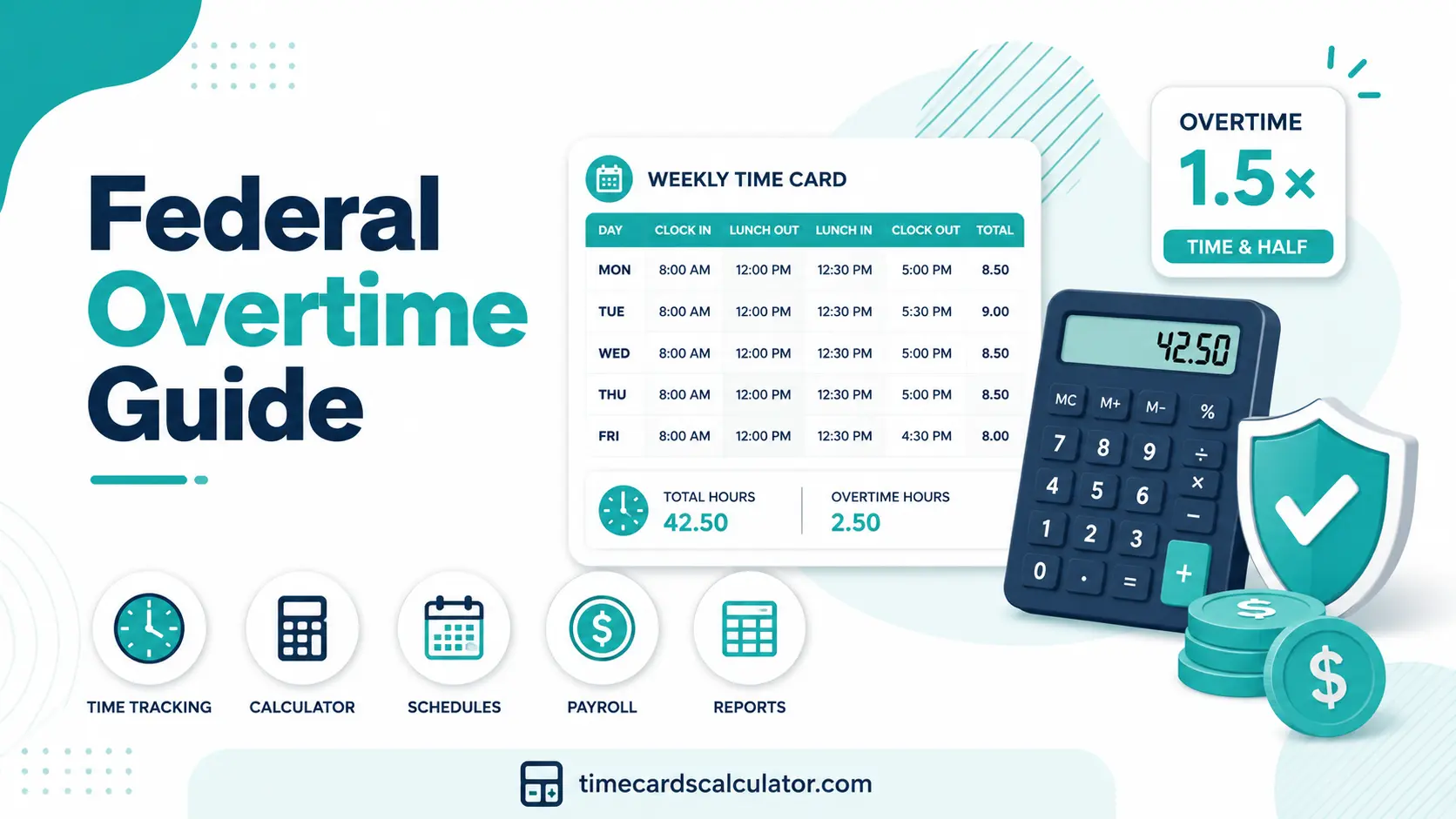
Quick Answer: Federal overtime under the FLSA requires non-exempt employees to be paid at least 1.5 times their regular rate of pay for every hour worked beyond 40 in a single workweek. The “regular rate” is not simply the hourly wage, it includes nondiscretionary bonuses, shift differentials, and commissions, which must be factored in before applying the 1.5x multiplier. Averaging hours across two weeks is illegal under federal law even on a biweekly pay schedule. For 2026, the exempt salary threshold remains $684 per week ($35,568 per year), and beginning this tax year, employers must separately report qualified overtime compensation in Box 14 of Form W-2.
Most small business owners learn the wrong version of overtime math first. Time and a half sounds like a simple multiplication problem until a week arrives where one employee worked two different jobs at two different rates, another earned a performance bonus, and a salaried supervisor turns out to be non-exempt. At that point, the “just multiply by 1.5” approach produces the wrong number, and the wrong number means underpayment, which means liability.
This guide walks through the federal overtime calculation from start to finish, covering the standard formula, every scenario that changes it, the 2026 W-2 reporting rule, and the misclassification mistakes that generate the most back-pay claims. If you want the math handled automatically, our free Time Card Calculator applies the correct FLSA formula to actual clock-in and clock-out data, no setup required.
Table of Contents
Federal Overtime Calculation: Quick Reference
| Scenario | Formula | Common Mistake |
|---|---|---|
| Single hourly rate | Regular rate × 1.5 × OT hours | Using base wage instead of true regular rate |
| Multiple pay rates | Weighted average × 0.5 × OT hours | Applying highest rate at 1.5x for all OT |
| Nondiscretionary bonus | (Wages + bonus) ÷ total hours = revised regular rate | Skipping bonus in regular rate calculation |
| Salaried nonexempt | Salary ÷ agreed hours = regular rate, then 0.5× premium | Assuming salary already covers OT |
| Tipped employee | Federal minimum wage ($7.25) × 1.5 = OT base | Using cash wage instead of full minimum wage as OT base |
| Biweekly pay period | Calculate each 7-day week separately | Averaging hours across both weeks |
Step 1: Define Your Workweek Correctly
Before any calculation can be right, the workweek has to be defined correctly, and this is where a lot of small business payroll goes wrong from the start.
A workweek under the Fair Labor Standards Act is a fixed, recurring period of seven consecutive 24-hour days, totaling 168 hours. The employer chooses when the workweek starts, Sunday midnight, Monday at 6 AM, Wednesday at noon. That choice is yours, but once you set it, it must stay consistent. Changing the workweek definition to avoid triggering overtime is a specific FLSA violation the Department of Labor looks for in audits.
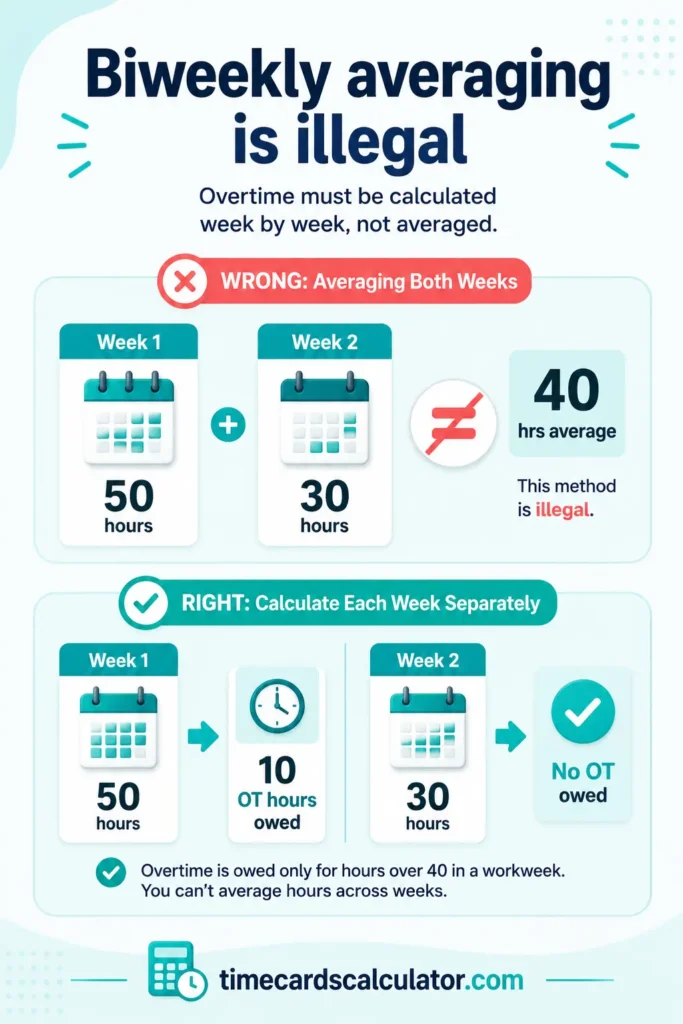
The seven-day window is the only unit the FLSA recognizes for overtime purposes. Hours cannot be averaged across two weeks, three weeks, or any other span, regardless of how often you run payroll.
This is one of the costliest misunderstandings in small business payroll. An employee who works 50 hours in week one and 30 hours in week two of a biweekly pay period averages out to 40 hours on paper. Under federal law, you still owe 10 hours of overtime for week one. Each workweek is calculated independently, always. Running payroll on a biweekly schedule does not change that.
Step 2: Calculate the Correct Regular Rate of Pay
Most overtime errors don’t start at the multiplication step. They start here, at the regular rate, because most employers assume the regular rate equals the hourly wage. Under the FLSA, it almost never does.
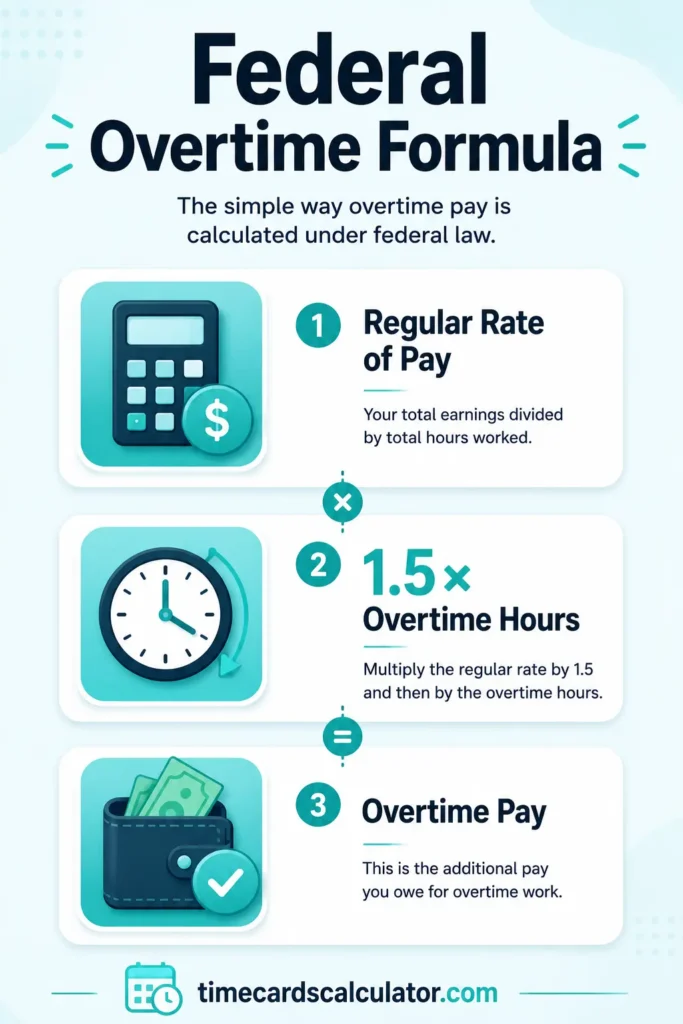
The DOL defines the regular rate as total workweek compensation divided by total hours worked. “Total compensation” includes the base hourly wage plus any nondiscretionary bonuses, shift differentials, on-call pay, and commissions earned during that workweek. If a payment was promised before the work was done, it is nondiscretionary and must be folded into the regular rate.
What gets excluded: discretionary bonuses announced at the employer’s sole discretion with no prior commitment, genuine expense reimbursements, overtime premiums already paid, and payments for idle time, vacation, or holidays not worked. Conservative best practice: when you are unsure whether a payment should be included, include it. Excluding a payment you should have included creates underpayment liability. Including one you could have excluded costs a small amount of extra overtime pay.
A worked example with a bonus
An employee earns $18 per hour and works 47 hours in a workweek. She also receives a $45 nondiscretionary production bonus for the week.
Step 1, straight-time earnings: 47 hours × $18 = $846 Step 2, add the bonus: $846 + $45 = $891 total compensation Step 3, revised regular rate: $891 ÷ 47 hours = $18.96 per hour Step 4, overtime pay: $18.96 × 1.5 × 7 overtime hours = $199.08 Step 5, total gross: (40 × $18.96) + $199.08 = $757.44 + $199.08 = $956.52
That $45 bonus raised the regular rate from $18.00 to $18.96, which increased every overtime hour by $1.44. Over a busy quarter with multiple bonus weeks, that difference accumulates into hundreds of dollars of understated overtime.
Step 3: Apply the Correct Formula for Your Pay Structure
Once the regular rate is correct, the multiplication is straightforward. But the formula changes depending on how the employee is paid. Three structures come up most often in small business payroll, and each one requires a slightly different approach.
Standard hourly: the full 1.5x method
The FLSA overtime formula for a single-rate hourly employee is: Regular Rate × 1.5 × Overtime Hours. This covers all hours above 40 in the workweek. Overtime hours are paid at the full time-and-a-half rate, not just a half-time premium on top of separately-paid straight time.
Multiple pay rates: the weighted average method
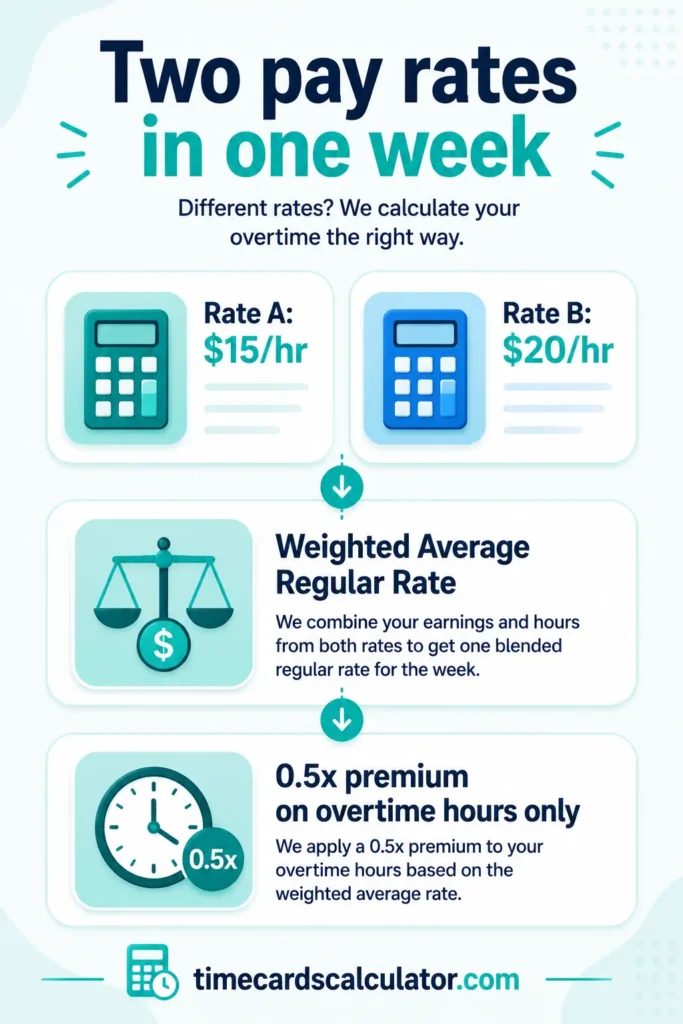
When an employee works at two different rates in the same workweek, the FLSA requires a blended regular rate. Most payroll systems that use the highest rate for all overtime hours produce the wrong number.
The correct method: add total straight-time earnings from all rates, divide by total hours worked to get the weighted average, then apply a 0.5x premium to overtime hours (because straight-time pay has already been included in the straight-time earnings).
Example: 20 hours at $15 per hour and 25 hours at $20 per hour, 45 total hours, 5 overtime hours.
Total straight-time earnings: (20 × $15) + (25 × $20) = $300 + $500 = $800 Weighted average regular rate: $800 ÷ 45 hours = $17.78 Overtime premium: $17.78 × 0.5 × 5 hours = $44.45 Total weekly gross: $800 + $44.45 = $844.45
This calculation must be run fresh every workweek because the blended rate changes whenever the mix of hours between the two roles changes.
Salaried nonexempt employees
Salaried status does not equal overtime exemption. An employee must meet all three FLSA tests (salary basis, salary level at $684 per week minimum, and duties) to be classified as exempt. If a salaried employee is nonexempt, the regular rate comes from dividing the weekly salary equivalent by the number of hours the salary is intended to cover.
If a $650 weekly salary is designated to cover 44 hours, the regular rate is $650 ÷ 44 = $14.77 per hour. Because straight-time pay for all 44 hours is already inside the salary, overtime for hours 41 through 44 is paid at only 0.5 × $14.77 = $7.39 per overtime hour. Hours beyond the agreed-upon covered number require the full 1.5x rate. Many small business owners miscalculate this because they assume the salary covers exactly 40 hours when no such specific agreement was ever documented.
These three pay structures, single rate, multiple rates, and salaried nonexempt, cover the majority of small business payroll situations. But they all assume one thing: that total compensation for the week is already known before the calculation starts. The moment a bonus or commission enters the picture, or an employee earns tips that affect the overtime base, that assumption breaks. Step 4 covers exactly that.
Step 4: Handle Bonuses, Commissions, and Multi-Period Adjustments
Bonuses and commissions are where overtime calculations most commonly go wrong, because they require a step that most payroll software skips by default: recalculating the regular rate upward before applying the overtime multiplier. The type of bonus determines whether it belongs in the calculation at all, and when it spans multiple weeks, the adjustment has to go backward, not just forward.
When a bonus spans multiple workweeks
If a bonus is tied to a single workweek, add it to that week’s compensation and recalculate the regular rate. If a bonus spans multiple weeks, such as a monthly production bonus paid at month end, you must retroactively recalculate the regular rate for each affected week and pay the resulting overtime differential.
This retroactive adjustment is one of the most commonly missed obligations in small business payroll, and it applies even after the original paychecks have already been issued. The DOL Fact Sheet on overtime covers this requirement directly.
The math: take the monthly bonus, divide it by the total hours worked during the month to get the addition to the regular rate per hour, then multiply that addition by 0.5 and by the overtime hours in each affected workweek. Issue supplemental payments for those overtime differentials.
Tipped employees: the overtime base wage is not the cash wage
Federal law allows employers to pay a direct cash wage as low as $2.13 per hour to tipped employees, with tips expected to make up the difference to the federal minimum of $7.25 per hour. For overtime purposes, however, the overtime base is the full $7.25 minimum wage, not the reduced cash wage.
Overtime for a tipped employee: $7.25 × 1.5 = $10.88 per overtime hour, minus the tip credit of up to $5.12 per hour, leaving a cash obligation of $5.76 per overtime hour.
Employers who calculate tipped overtime using the $2.13 cash wage as the base are systematically underpaying every tipped employee who works more than 40 hours in a week, shift after shift.
Step 5: Know What the 2026 W-2 Rule Adds to Your Records Obligation
Starting with the 2026 tax year, employers are required to separately report qualified overtime compensation in Box 14 of Form W-2. This requirement flows from the OBBBA overtime tax deduction, which allows eligible non-exempt employees to deduct up to $12,500 in overtime premium pay from their federal income taxes.
Qualified overtime compensation is defined specifically as the half-time premium portion of overtime pay (the 0.5x above the regular rate) for employees who are FLSA-eligible non-exempt workers. The deduction phases out for individuals earning $150,000 or more per year.
This rule does not change how overtime is calculated. What it does change is the records obligation. Accurate timecards are no longer just an internal payroll document. The hours and overtime amounts recorded on each employee’s timecard now feed directly into what appears on their W-2 and what they are able to deduct on their federal tax return. A systematic timekeeping error that understates overtime hours creates a tax reporting error, not just a wage claim.
Step 6: Misclassification Risks and What They Cost
The most expensive overtime mistake is classifying a non-exempt employee as exempt. Exemption requires passing all three FLSA tests simultaneously: salary basis (fixed weekly amount not subject to reduction), salary level ($684 per week minimum under current federal rules), and duties (primarily executive, administrative, or professional work as defined by DOL). Failing even one test means the employee is non-exempt and owed overtime.
The executive exemption specifically requires that the employee’s primary duty is managing the enterprise or a department, that they regularly direct two or more full-time employees, and that they have genuine authority over hiring, firing, or personnel decisions. An employee with a “manager” or “supervisor” title who spends the majority of their time performing the same tasks as the people they nominally oversee does not pass the duties test.
What misclassification actually costs
Back pay: the employer owes unpaid overtime for the entire misclassification period, up to two years under a standard claim, or three years if the violation is found to be willful.
Liquidated damages: courts can double the back pay award as an additional penalty, meaning a $20,000 back pay claim becomes a $40,000 judgment.
Civil penalties: the DOL can assess civil penalties of up to $2,515 per violation for repeated or willful FLSA violations.
Attorney fees: employers generally pay the employee’s legal costs if the employee prevails.
A single misclassified employee who worked overtime for two years, earning $18 per hour with regular 48-hour weeks, generates roughly $14,000 in back pay before liquidated damages. The liquidated damages double that to $28,000, and attorney fees typically add more. Misclassification is not a technicality.
Common Mistakes That Generate Back Pay Claims
Omitting a nondiscretionary bonus from the regular rate is the most common single error in small business payroll. If any bonus is promised before the work period begins, it belongs in the rate.
Averaging hours across a biweekly pay period is illegal under the FLSA regardless of how payroll is processed. Each seven-day workweek stands alone.
Using an inconsistent workweek definition, or shifting the workweek start day after a busy stretch to avoid overtime, is a specific violation that auditors look for.
Assuming a salary creates an exemption without checking the duties test. Paying someone a salary is only the first step.
Failing to recalculate the regular rate after a retroactive bonus payment for the affected weeks.
For any employer running hourly payroll, accurate time records are the foundation of all of the above. Our free Time Card Calculator captures actual clock-in and clock-out data, calculates the correct regular rate, and flags overtime automatically, removing the manual calculation step where most of these errors originate. For teams tracking multiple employees, the multiple employee time cards tool handles each worker’s rate and overtime separately in one view.
In Short
Federal overtime calculation starts with one non-negotiable rule: define a fixed seven-day workweek, calculate each week independently, and never average hours across a biweekly pay period. From there, the regular rate must include every nondiscretionary payment before the 1.5x multiplier is applied. Multiple pay rates require a weighted average. Salaried nonexempt employees need a salary-to-hourly conversion. Tipped employees have an overtime base wage that is the full federal minimum, not the cash wage. And for 2026, every overtime hour recorded on a timecard now matters for each employee’s W-2 and tax filing. Getting the federal overtime calculation right protects both the business from liability and the workers from underpayment.
Frequently Asked Questions
What is the federal overtime calculation formula?
The FLSA formula is: Regular Rate of Pay × 1.5 × Overtime Hours. Overtime hours are all hours worked beyond 40 in a single fixed workweek. The regular rate is total workweek compensation divided by total hours worked, which means it must include nondiscretionary bonuses, shift differentials, and commissions, not just the base hourly wage.
Can I average hours across a biweekly pay period to avoid overtime?
No. The FLSA calculates overtime on a workweek basis only, defined as a fixed, recurring seven-day period. If an employee works 50 hours in week one and 30 hours in week two of a biweekly pay period, you owe 10 hours of overtime for week one regardless of the 30-hour week that follows it. Averaging is specifically prohibited under federal law.
How does a nondiscretionary bonus change the overtime calculation?
A nondiscretionary bonus must be added to the employee’s total workweek compensation before the regular rate is calculated. The regular rate goes up, which means every overtime hour for that week is also worth more. If the bonus covers multiple weeks, you must retroactively recalculate the regular rate for each affected week and pay supplemental overtime differentials.
How do you calculate overtime for an employee who worked two different pay rates in the same week?
Use the weighted average method. Add total straight-time earnings from both rates, divide by total hours worked to get the blended regular rate, then apply a 0.5x premium to overtime hours (since straight-time pay is already included in the earnings). Do not use the higher rate at 1.5x for all overtime hours — that produces the wrong number.
Is a salaried employee always exempt from overtime?
No. Salaried status alone does not create an exemption. The employee must pass three tests: paid on a fixed salary basis, earning at least $684 per week, and primarily performing exempt executive, administrative, or professional duties. If any test fails, the employee is non-exempt and owed overtime, which is calculated by dividing the weekly salary by the agreed covered hours to find the regular hourly rate.
How is overtime calculated for tipped employees?
The federal overtime base for tipped employees is the full federal minimum wage of $7.25 per hour, not the reduced cash wage of $2.13. Overtime rate is $7.25 × 1.5 = $10.88 per overtime hour. The employer then subtracts the allowable tip credit (up to $5.12 per hour) to determine the cash obligation. Using the cash wage as the overtime base is a systematic underpayment violation.
What is the 2026 W-2 Box 14 overtime reporting requirement?
Starting with the 2026 tax year, employers must separately report qualified overtime compensation in Box 14 of Form W-2. Qualified overtime is the half-time premium portion (the 0.5x above the regular rate) paid to FLSA-eligible non-exempt employees for hours over 40. This reporting enables employees to claim the OBBBA overtime tax deduction of up to $12,500 on their federal return. The rule does not change how overtime is calculated, but it means accurate timecards now directly affect employee tax filings.
What happens if a small business misclassifies an employee as exempt?
The employer owes back pay for all unpaid overtime, going back two years for standard violations or three years for willful ones. Courts can double the back pay award as liquidated damages. The DOL can assess civil penalties of up to $2,515 per willful violation. Attorney fees are typically paid by the employer if the employee wins. A single misclassified employee working moderate overtime for two years can generate tens of thousands of dollars in total exposure.
Does the FLSA apply to all small businesses?
The FLSA applies to employers with at least $500,000 in annual gross sales or business done, and also covers individual employees whose work involves interstate commerce, which courts interpret broadly enough to cover almost all employees in practice. Small business status alone does not create an exemption from the overtime rules.
How do I keep overtime records for the 2026 W-2 reporting requirement?
For each non-exempt employee, track total hours worked per workweek, the regular rate for each week (including any bonuses or differentials), total overtime hours, and the half-time premium paid for those overtime hours. That last figure is what gets reported in W-2 Box 14. A digital time card system that records actual clock-in and clock-out data and calculates the regular rate automatically is the most reliable way to maintain these records without manual error.
Putting It All Together
Federal overtime calculation is not a single formula. It is a sequence of steps, each one dependent on the one before it. The workweek has to be correct before hours can be counted. The regular rate has to be correct before the multiplier can be applied. And the regular rate can only be correct if every nondiscretionary payment for the week is included.
Most small business overtime errors are not intentional. They come from applying the simple version of the formula to situations where the simple version does not fit. Multiple rates, bonuses, tipped employees, and salaried nonexempt workers each require a different approach, and getting it wrong on any of them creates back pay liability that compounds over time.
Our free Time Card Calculator handles the hours and overtime math automatically based on actual clock-in and clock-out data. For teams, the multiple employee time cards tool runs each worker’s calculation separately. Export to PDF or CSV for payroll records, and as of the 2026 tax year, for the W-2 Box 14 documentation each employee needs at tax time. Free, no account required.
Discover More
- Free Time Card Calculator — Calculate hours, regular rate, and overtime automatically with your actual clock-in and clock-out data
- Exempt vs. Non-Exempt Employees — Full guide to the three-part FLSA exemption test and 2026 salary thresholds by state
- California Overtime Rules — Daily overtime after 8 hours, double time after 12, and the 7th consecutive day rule
- No Tax on Overtime (OBBBA) — How the 2025 overtime tax deduction works and who qualifies for the $12,500 deduction
- Free Timesheet Templates — Weekly, biweekly, and monthly templates in Excel, Google Sheets, and PDF