Quick Answer: Colorado labor laws in 2026 give workers more protection than federal law in several areas. The minimum wage adjusts every January based on inflation and is higher than the federal $7.25 rate. Overtime applies after 12 hours in a day, 40 hours in a week, or 12 consecutive hours, whichever gives more pay. Employees get a paid 10 minute rest break every 4 hours & an unpaid 30 minute meal break after 5 hours. Nearly all employers must provide paid sick leave under the HFWA, and Colorado runs its own paid family leave program called FAMLI. Final paychecks are due immediately upon firing, or by the next payday if quitting.
Colorado has some of the more detailed labor laws in the country, and they change often enough that what was true two years ago might not be true now. Minimum wage adjusts every January based on inflation. Sick leave rules expanded statewide a few years back and still trip up small employers. And the rules for breaks, overtime, and final paychecks are stricter than federal law in several places, which catches a lot of people off guard if they’re used to how things work elsewhere.
This guide pulls together the rules that matter most for hourly and salaried workers in Colorado: minimum wage, overtime, meal and rest breaks, sick leave, family leave, termination, and a few areas specific to minors and pregnant workers. Where Colorado pay laws are strict than federal law, Colorado wins, employers have to follow whichever standard is more favorable to the employee.
Table of Contents
Colorado Minimum Wage 2026
As of January 1, 2026, Colorado’s state minimum wage adjusts annually based on the Consumer Price Index, which means it typically increases by a small amount each year rather than staying flat. Check the Colorado Department of Labor and Employment website for the exact current figure, since it updates every January and a guide like this can fall behind by a few cents.
What matters more than the exact number is understanding how it works. Colorado’s minimum wage is higher than the federal minimum wage of $7.25 per hour, and employers must pay whichever is higher. Some cities, Denver in particular, set their own local minimum wage that’s higher still, so an employer in Denver has to pay the Denver rate, not the statewide rate, if Denver’s is higher.
Tipped Employees in Colorado
For tipped employees, like servers and bartenders, employers can pay a lower direct cash wage and count tips toward the rest, this is called a tip credit. Colorado’s tip credit is a fixed dollar amount subtracted from the standard minimum wage, currently set at $3.02 per hour. So if the standard minimum wage is, for example, $14.81, a tipped employee’s direct cash wage could be as low as $11.79, with tips expected to make up the difference. If an employee’s tips don’t bring them up to the full minimum wage in a given week, the employer is required to make up the shortfall.
Colorado Overtime Law
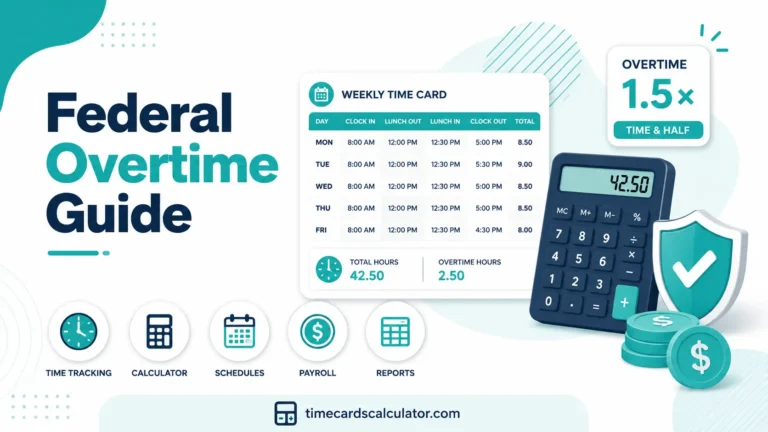
Colorado overtime rules come from the COMPS Order (Colorado Overtime and Minimum Pay Standards Order), issued by the CDLE, and they’re broader than the federal FLSA rules in one key way: Colorado has a daily overtime threshold, not just a weekly one.
Under Colorado law, non-exempt employees are entitled to overtime pay at 1.5 times their regular rate for any of the following, whichever results in more overtime pay:
Hours worked beyond 12 in a single workday. Hours worked beyond 40 in a single workweek. Hours worked beyond 12 consecutive hours, regardless of when the workday starts or ends.
This daily threshold is similar to California’s rule, and it’s a common surprise for employers moving operations to Colorado from states that only follow the federal 40 hour weekly standard. If you need to calculate Colorado overtime for your team, our free time card calculator handles daily and weekly overtime thresholds, you can set the daily threshold to 12 hours to match Colorado’s rule.
Exempt vs Non-Exempt in Colorado
Like federal law, Colorado distinguishes between exempt employees, generally salaried workers in executive, administrative, or professional roles meeting a minimum salary threshold, and non-exempt employees, who are entitled to overtime. Colorado’s salary threshold for exemption is set separately from the federal threshold and is also adjusted periodically, so an employee classified as exempt under federal rules isn’t automatically exempt under Colorado rules if their salary falls below the state threshold.
Colorado Break Laws
Colorado requires both meal breaks and rest breaks for most hourly employees, and the rules are more specific than many states.
Meal Breaks
Employees who work a shift of 5 consecutive hours or more are entitled to an unpaid meal break of at least 30 minutes. This break must be uninterrupted, if an employee is required to stay on duty, answer calls, or remain available during their meal break, it’s considered “on duty” and must be paid. A common point of confusion: if an employer can’t reasonably relieve an employee of all duties for a meal break (for example, a solo worker who must stay near the register), the employee must be paid for that time even if they’re technically on a “break.”
Rest Breaks
In addition to meal breaks, employees are entitled to a paid 10 minute rest break for every 4 hours worked, or major fraction thereof. These rest breaks are separate from meal breaks and must be paid, they can’t be combined with the meal break or skipped in exchange for leaving early.
What Happens If Breaks Are Denied
If an employer doesn’t provide a required meal or rest break, the employee may be entitled to additional compensation for that time, and repeated violations can be reported to the CDLE’s Division of Labor Standards and Statistics.
Colorado Sick Leave Law (Healthy Families and Workplaces Act)
The Healthy Families and Workplaces Act (HFWA) requires nearly all Colorado employers, regardless of size, to provide paid sick leave to employees. The core rules:
Employees accrue 1 hour of paid sick leave for every 30 hours worked, up to a minimum of 48 hours per year (employers can offer more). Accrued leave carries over year to year, though employers can cap usage at 48 hours per year. Leave can be used for the employee’s own illness, to care for a family member, for safety leave related to domestic violence or sexual assault, or for public health emergency closures.
During a declared public health emergency, like the provisions that were added during the COVID-19 pandemic, employers with 16 or more employees must provide up to 80 additional hours of leave, separate from the standard accrued leave, specifically for the emergency.
Colorado Family and Medical Leave (FAMLI)
Colorado runs its own paid family and medical leave insurance program, called FAMLI, separate from the federal FMLA. FAMLI provides up to 12 weeks of paid leave (up to 16 weeks in certain pregnancy or childbirth complication cases) for employees dealing with their own serious health condition, caring for a family member with a serious health condition, bonding with a new child, or certain military family needs.
FAMLI is funded through small payroll premiums split between employers and employees (employers with fewer than 10 employees aren’t required to pay the employer share, but employees still contribute and are still eligible for benefits). This is different from FMLA, which is unpaid and only applies to employers with 50 or more employees, FAMLI applies much more broadly and actually pays benefits during leave.
Colorado At Will Employment and Termination Laws
Colorado is an at will employment state, meaning either the employer or employee can end the employment relationship at any time, for almost any reason, or no reason at all, as long as the reason isn’t illegal (discriminatory, retaliatory, or in violation of a contract).
Final Paycheck Rules
When an employee is fired (involuntary termination), Colorado law requires the employer to pay all final wages immediately, at the time of termination, or the next regular payday if the employer’s accounting unit is closed at the time. When an employee quits (voluntary termination), final wages are due on the next regular payday.
This is stricter than many states, where employers get a window of several days regardless of why the employee left. Failing to pay final wages on time in Colorado can result in penalties, the unpaid wages can accrue a daily penalty in addition to what’s owed.
Colorado Child Labor Laws
Colorado restricts both the hours and types of work minors can perform, with different rules depending on age.
Minors under 14 generally cannot be employed except in specific exempted categories (like agricultural work for a family farm, or entertainment with proper permits). Minors aged 14 and 15 can work limited hours, generally not during school hours, with restrictions on how late they can work on school nights versus non-school nights. Minors aged 16 and 17 have fewer hour restrictions but still cannot work in hazardous occupations as defined by state and federal law.
Most minors working in Colorado need a work permit, typically obtained through their school, before starting a job. Employers hiring minors should verify age documentation and keep records of work permits on file.
A common question is “can you get a job at 15 in Colorado”, and the answer is generally yes, with restrictions on hours (especially during the school year) and on the type of work, hazardous jobs like operating certain machinery are off limits regardless of permit status.
Colorado Pregnant Workers Fairness Act
This law requires employers to provide reasonable accommodations to employees for conditions related to pregnancy, childbirth, or related medical conditions, things like more frequent breaks, modified duties, seating, or temporary transfer to a less strenuous role, unless doing so would cause undue hardship to the employer. Employers also cannot deny employment opportunities, force an employee to take leave, or retaliate against an employee for requesting an accommodation under this law.
Discrimination, Harassment & Filing a Complaint
Colorado prohibits employment discrimination based on protected characteristics including race, sex, age, disability, religion, national origin, sexual orientation, and gender identity, among others, through both state law (administered by the Colorado Civil Rights Division) and federal law (EEOC).
For wage related complaints specifically, sick leave, overtime, minimum wage, final paycheck issues, the CDLE’s Division of Labor Standards and Statistics handles complaints and investigations. For discrimination or harassment complaints, the Colorado Civil Rights Division is the relevant state agency. Employees generally have a limited window of time to file a complaint after the incident, so timing matters if you’re considering this route.
Colorado vs. Federal Law: Quick Comparison
| Rule | Federal Standard | Colorado Standard |
|---|---|---|
| Minimum wage | $7.25 per hour, fixed | Higher, adjusts every January |
| Overtime threshold | Over 40 hours per week only | Over 12 hours per day, 40 per week, or 12 consecutive hours |
| Meal break | Not required by federal law | 30 minutes unpaid after 5 hours worked |
| Rest break | Not required by federal law | 10 minutes paid every 4 hours |
| Paid sick leave | Not required by federal law | Required for nearly all employers (HFWA) |
| Paid family leave | Unpaid only (FMLA), 50+ employees | Paid for nearly all employers (FAMLI) |
| Final paycheck after firing | Varies, often a few days | Immediately, or next payday if office closed |
In Short
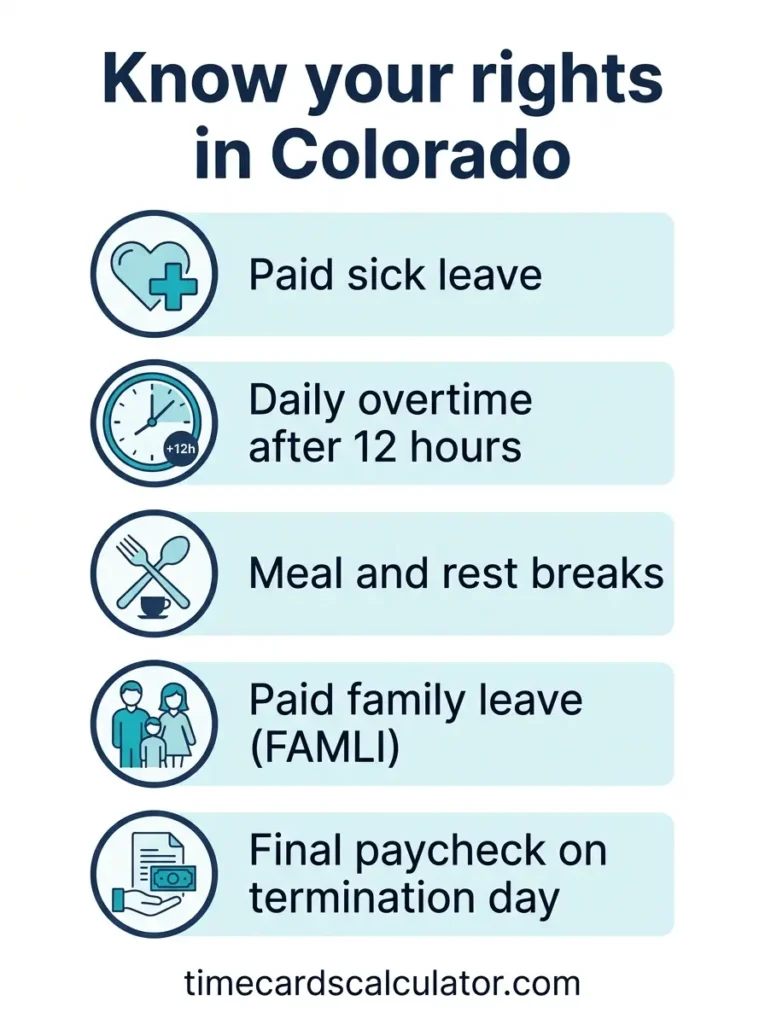
Colorado labor law gives employees more protection than federal law in several key areas: a daily overtime threshold on top of the weekly one, mandatory paid sick leave for nearly all employers, a state run paid family leave program, and stricter final paycheck deadlines after termination. If you’re an employer, the safest approach is to default to whichever standard, state or federal, gives the employee more protection. If you’re an employee, knowing these baseline rules helps you recognize when something doesn’t look right.
Frequently Asked Questions (FAQs)
What is the minimum wage in Colorado for 2026?
Colorado’s minimum wage adjusts every January 1st based on the Consumer Price Index, so it increases slightly most years. It’s always higher than the federal minimum wage of $7.25, and employers must pay the higher of the two. Some cities, including Denver, have their own local minimum wage that can be higher than the statewide rate. Check the Colorado Department of Labor and Employment website for the current exact figure.
Does Colorado Follow the Federal Fair Labor Standards Act (FLSA)?
Yes, Colorado employers must comply with the federal FLSA as a baseline. However, Colorado has its own state law, the COMPS Order, which sets stricter standards in several areas (minimum wage, daily overtime, breaks). When state and federal rules differ, employers must follow whichever law favors the employee more, which in Colorado’s case is almost always the state rule. In short: FLSA sets the floor, COMPS Order sets the actual standard most Colorado workers experience.
Does Colorado have daily overtime, or only weekly?
Both. Colorado is one of the few states with a daily overtime threshold in addition to the standard weekly one. Non-exempt employees are entitled to overtime pay for hours worked beyond 12 in a single day, beyond 40 in a single week, or beyond 12 consecutive hours, whichever results in more overtime.
How does sick leave work in Colorado?
Under the Healthy Families and Workplaces Act, employees accrue 1 hour of paid sick leave for every 30 hours worked, with a minimum of 48 hours available per year. It can be used for the employee’s own illness, to care for a sick family member, or for safety related leave. Unused leave generally carries over, though employers can cap annual usage at 48 hours.
Is Colorado an at will employment state?
Yes. Either the employer or employee can end employment at any time for almost any reason, or no reason, as long as it isn’t illegal, meaning not discriminatory, retaliatory, or in violation of an existing contract.
What are Colorado’s break laws?
Employees working 5 or more consecutive hours are entitled to an unpaid 30 minute meal break that must be uninterrupted, or paid if the employer can’t fully relieve them of duties. Separately, employees get a paid 10 minute rest break for every 4 hours worked.
How late can minors work in Colorado?
It depends on age and whether it’s a school night. Minors aged 14 and 15 face the most restrictions, generally limited hours on school nights and a later cutoff on non-school nights. Minors 16 and 17 have more flexibility but are still restricted from hazardous occupations. Most minors need a work permit, usually obtained through their school.
What is Colorado FAMLI and how is it different from FMLA?
FAMLI is Colorado’s own paid family and medical leave insurance program, funded by small payroll premiums and providing up to 12 weeks (16 in some pregnancy cases) of paid leave. FMLA is the federal program, which is unpaid and only covers employers with 50 or more employees. FAMLI applies to nearly all Colorado employers and actually pays benefits, which is the key difference.
How soon must a final paycheck be issued in Colorado after termination?
If an employee is fired, final wages are due immediately, at the time of termination, or by the next payday if the payroll office is closed. If an employee quits voluntarily, final wages are due on the next regular payday. Late final paychecks can result in daily penalties for the employer.
Is overtime calculated the same way in Colorado as in California?
Similarly, but not identically. Both states use a daily overtime threshold in addition to a weekly one, Colorado’s daily threshold is 12 hours, California’s is 8 hours with an additional double time rule after 12 hours. California also has a 7th consecutive day rule that Colorado doesn’t have in the same form. If you work across both states, don’t assume the rules transfer directly.
Where do I file a labor complaint in Colorado?
For wage issues, unpaid overtime, minimum wage violations, missed breaks, final paycheck problems, contact the CDLE’s Division of Labor Standards and Statistics. For discrimination or harassment, the Colorado Civil Rights Division handles those complaints. Both have online complaint forms and a limited time window to file after the incident occurs.
Related Tools and Guides
- Free Time Card Calculator, calculate hours, breaks, and overtime, including custom daily thresholds for Colorado’s 12 hour rule
- California Overtime Calculator, for comparing Colorado’s daily overtime rule to California’s
- Free Timesheet Templates, including templates that handle daily overtime thresholds
This guide is for general informational purposes and reflects Colorado labor law as commonly understood for 2026. Labor laws change, including annual minimum wage adjustments, so for specific situations or current exact figures, consult the Colorado Department of Labor and Employment or a licensed employment attorney.